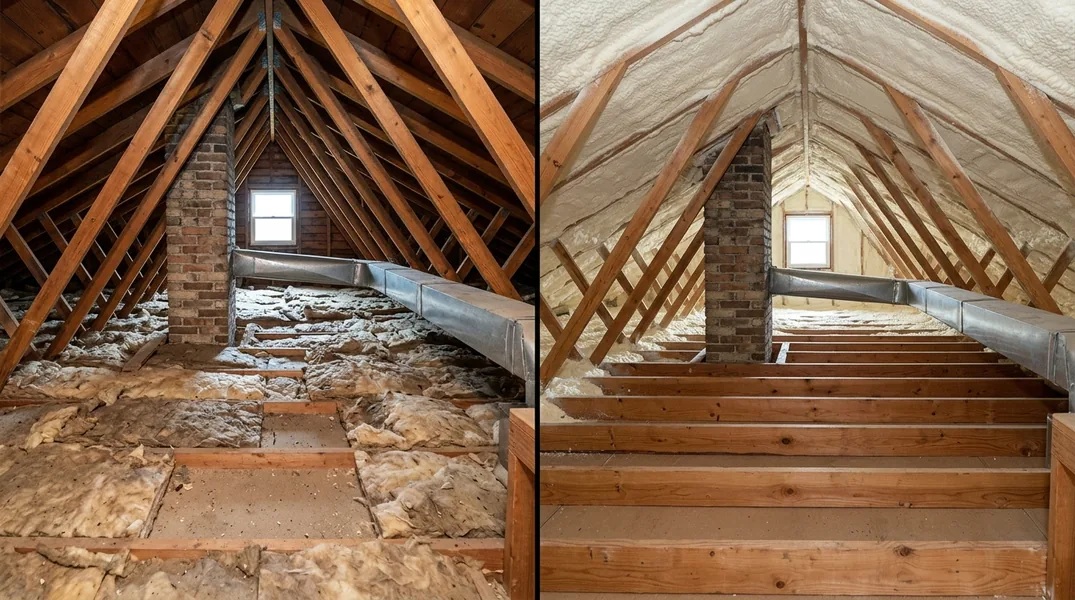
The Insulation Problem in Mid-Century Ranch Homes
If you own a mid-century ranch home in Montgomery or Oswego, you likely appreciate the classic charm and solid construction of these properties. However, one challenge that many homeowners face is inadequate attic insulation. Homes built in the 1950s and 1960s were often constructed with minimal insulation by today's standards, and decades of settling and degradation have only made the problem worse.
Thin or deteriorated attic insulation leads to significant energy loss. During winter, heat escapes through your roof, forcing your heating system to work harder and driving up utility bills. In summer, heat penetrates into your living spaces, making air conditioning less effective. Beyond comfort and cost, insufficient insulation can also lead to moisture buildup, ice dams, and potential structural damage over time. If you've noticed rising energy costs or uneven temperatures throughout your home, your attic insulation is likely the culprit.
The good news is that modern insulation solutions can transform your home's energy performance. Whether you live in Aurora or the surrounding communities, upgrading your attic insulation is one of the most cost-effective improvements you can make. The key is choosing the right insulation type for your specific situation.
Spray Foam vs. Blown-In Insulation: Which Performs Better?
When comparing spray foam vs blown in insulation, the differences are striking. Blown-in insulation, typically made from fiberglass or cellulose, is installed by blowing loose material into your attic cavity. While this method is relatively affordable and quick, it has notable limitations. Blown-in materials settle over time, reducing their R-value effectiveness. They cannot seal air leaks, which means warm or cool air continues to escape through cracks, gaps, and around penetrations like electrical wires and plumbing vents.
Attic Spray Foam Insulation works fundamentally differently. When applied, liquid foam expands to fill every cavity, crack, and gap in your attic space. It creates an airtight seal that prevents air infiltration, which is responsible for up to 30 percent of heating and cooling loss in many homes. Unlike blown-in materials, spray foam doesn't settle or degrade over time. It maintains its R-value for decades, providing consistent performance year after year. This superior air sealing capability makes spray foam the clear winner for energy efficiency in older homes with compromised attic spaces.
Spray Foam vs. Fiberglass: Understanding the Key Differences
Fiberglass batts and rolls have been the industry standard for decades, and many mid-century homes still have original fiberglass insulation in their attics. When evaluating spray foam vs fiberglass, several important factors emerge. Fiberglass has a moderate R-value per inch (around 3.2 to 3.8), but its effectiveness depends heavily on proper installation. Gaps, compression, and air bypassing around the fiberglass significantly reduce its actual performance in real-world conditions. Additionally, fiberglass can absorb moisture, which reduces its insulating properties and creates conditions for mold growth in humid climates.
Spray foam offers superior performance in nearly every metric. It achieves higher R-values per inch, typically 6 to 7 for closed-cell varieties. More importantly, it eliminates air leakage entirely. Closed Cell Spray Foam Insulation is particularly effective because it creates a vapor-tight barrier, preventing moisture infiltration and protecting your attic structure from water damage. For homeowners dealing with thin fiberglass insulation in older ranches, upgrading to spray foam represents a dramatic improvement in comfort, efficiency, and home protection.
Spray Foam vs. Cellulose: Why Spray Foam Wins for Attic Applications
Cellulose is an eco-friendly insulation option made from recycled paper, and it has gained popularity in recent years. When comparing spray foam vs cellulose, both have environmental merits, but spray foam delivers superior performance for attic insulation. Cellulose has a decent R-value of about 3.6 per inch, but like fiberglass, it settles over time and doesn't address air leakage. Cellulose is also hygroscopic, meaning it absorbs moisture from the air. In humid conditions or after water exposure, cellulose can retain moisture, leading to mold growth and structural rot. Some cellulose products are treated with fire retardants, but these treatments can degrade over time.
Spray foam, particularly Open Cell Spray Foam Insulation, offers better moisture management in certain applications, while closed-cell varieties provide complete vapor barriers. More critically, spray foam's air-sealing properties address the root cause of energy loss that cellulose cannot. For homeowners in Montgomery and Oswego looking to maximize the performance of their attic upgrades, spray foam is the most reliable choice. It won't settle, won't absorb moisture in the same way, and will maintain its effectiveness for the life of your home.
What Is the Best Insulation for Attic Spaces in Older Homes?
Determining the best insulation for attic depends on your specific home, budget, and performance goals. For mid-century ranches with thin or failing insulation, spray foam consistently emerges as the superior solution. It addresses multiple problems simultaneously: it boosts R-value, eliminates air leakage, prevents moisture intrusion, and improves structural integrity by providing rigidity to roof assemblies. Spray foam also allows you to achieve higher total R-values in the same physical space compared to traditional batts or blown-in materials, which is especially valuable when attic height is limited.
The best insulation for attic applications also depends on whether you're insulating between rafters, over joists, or sealing rim joists and penetrations. Spray foam's versatility makes it ideal for complex attic geometries found in older homes. Whether you need to address specific problem areas or perform a complete attic overhaul, spray foam adapts to your home's unique configuration. If you're ready to explore whether spray foam is right for your Aurora-area home, contact Aurora Spray Foam Insulation at (331) 258-5715 to discuss your project.
Attic Spray Foam Insulation Cost in Aurora: What to Budget
Understanding spray foam insulation pricing helps you make an informed decision. The cost of spray foam installation varies based on attic size, existing insulation conditions, accessibility, and whether you choose open-cell or closed-cell foam. Open-cell spray foam is typically less expensive per square foot but offers a lower R-value and is permeable to moisture. Closed-cell spray foam costs more upfront but delivers higher R-values and superior moisture protection, making it the better long-term investment for most homeowners.
While spray foam has a higher initial cost than blown-in insulation or fiberglass batts, the return on investment is substantial. The energy savings from improved efficiency often recoup the installation cost within five to ten years, depending on your local climate and energy rates. Additionally, spray foam's durability means you won't need to replace or add insulation in ten or fifteen years like you might with traditional materials. For a personalized quote based on your home's specific needs, reach out to Aurora Spray Foam Insulation for a free estimate. Our team will assess your attic and provide transparent pricing options tailored to your situation.
Looking for a professional spray foam insulation contractor in Aurora? Aurora Spray Foam Insulation responds fast for all your spray foam insulation needs.
Get a Free Quote