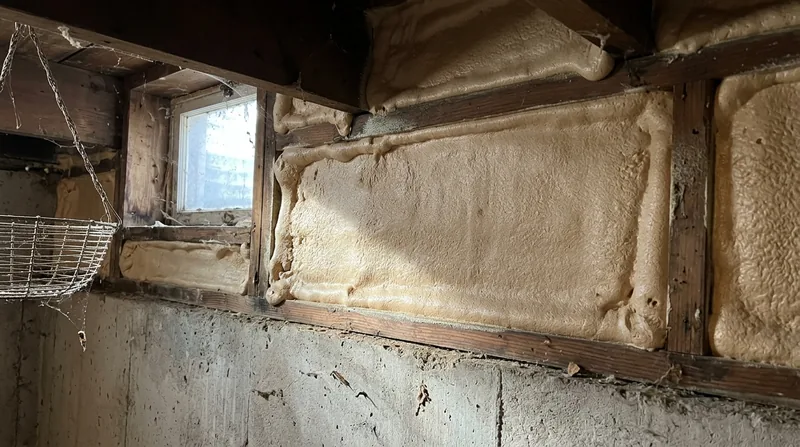




Rim joist and band joist spray foam insulation in Aurora stops the cold air leaks that drain heating costs every winter across Kane, DuPage, and Will counties. The rim joist is the band of wood framing that sits on top of your foundation wall, and it is one of the largest uninsulated cavities in most Aurora basements. During the windy, snow-heavy winters of IECC zone 5A, cold air pushes through gaps in that rim joist and around rim board seams, and the concrete foundation below it sweats in summer when humid outdoor air hits the cold basement. We spray closed cell foam along the rim and band joist to seal those cavities, stop the drafts, and control the condensation that eats at wood framing and sill plates. The work takes a day or less on most basements in Aurora, Naperville, Joliet, and Oswego, and it is one of the fastest ways to cut heating loss and protect the structural wood that holds your house up.
Why Rim Joist and Band Joist Spray Foam Matters in Aurora Basements
The pre-war and mid-century homes that fill Aurora's neighborhoods along the Fox River and through the older blocks near downtown were built with full basements and rim joists that were never insulated. The rim joist sits above the foundation wall and carries the weight of the first floor, and it runs the entire perimeter of your basement. When outdoor air temperature drops to 10 degrees Fahrenheit on a January night, that uninsulated rim joist becomes a direct conduit for cold air into the rim board cavity and into the band joist above it. The result is a draft at the rim, a cold floor above it, and heating bills that climb every winter.
- Rim joists and band joists are exposed to outdoor air pressure and temperature swings, and they have no insulation in most Aurora basements built before 1990.
- Cold air leaks through rim board seams, gaps around rim joist fasteners, and where the rim meets the sill plate, driving heat loss in winter and making basement floors feel cold.
- Summer humidity condenses on the cold concrete foundation and wicks into the wood framing, leading to rot, mold risk, and structural decay over decades.
- Closed cell foam seals the rim joist cavity to R-value 6.5 to 8 per inch, stopping the air leaks and creating a vapor barrier that controls moisture on both sides of the assembly.
- A sealed rim joist also quiets vibration and noise transmission between floors and reduces the load on your heating system during peak winter demand.
The rim joist is the entry point for most Aurora homeowners who want to cut heating loss without tearing into walls or attics first.
Key info: A typical Aurora basement rim joist runs 120 to 180 linear feet around the perimeter. Closed cell spray foam applied to a 12-inch depth seals the entire rim board cavity and the rim joist band, protecting wood framing and blocking cold air in one pass. Most basements in North Aurora and Batavia see heating loss cut by 10 to 15 percent after rim joist sealing.
For more detail on the technical advantages of closed cell foam, see our closed cell spray foam insulation page.
How We Spray Rim Joist and Band Joist Foam in Aurora Basements
Our process starts with a site visit to measure the rim joist cavity, check the condition of the wood framing, and confirm there is no active moisture or standing water in the basement. We do not spray over a wet or leaking substrate, and we walk away if the moisture problem needs to be fixed first. Once we confirm the rim is dry and ready, we set up mechanical ventilation in the basement to manage airflow during cure, and we control the spray equipment to apply closed cell foam at the correct ratio and drum temperature.
- We inspect the rim joist cavity, the band joist, and the foundation wall to confirm the surface is clean, dry, and free of gaps that could trap foam.
- We set up continuous mechanical ventilation to manage fumes and ensure proper curing throughout the basement during and after the spray.
- We spray closed cell foam in controlled passes, building thickness in layers to achieve the specified R-value and to ensure even coverage without voids or thin spots.
- We allow the foam to cure for 24 to 48 hours before you re-enter the basement, and we provide written guidance on re-entry windows and post-cure behavior.
- We walk the rim joist with you after cure to confirm the foam is solid, fully adhered, and free of gaps, and we address any minor touch-ups on the spot.
The whole job on a typical Aurora basement takes one day, and you do not need to leave your home or arrange alternative living space.
Example: A 1950s split-level in Oswego with a 140-foot rim joist and a finished basement room took us 5 hours from setup to mechanical ventilation shutdown. We sprayed 12 inches of closed cell foam into the rim cavity, sealed the band joist completely, and the homeowner re-entered the basement after 36 hours. The basement floor stopped feeling cold within a week, and the heating bill for January dropped by 12 percent compared to the prior year.
For a complete walkthrough of our spray process and air sealing approach, visit our air sealing service page.
| Approach | Description | Best for |
|---|---|---|
| Closed Cell Spray Foam (Standard) | High-density closed cell foam applied to 12-inch depth, R-value 6.5 to 8 per inch, full vapor barrier, stops air leaks and controls condensation. | Most Aurora rim joists, especially in older homes with damp basements or finished rooms below the first floor. |
| Closed Cell Spray Foam (Thicker Application) | Closed cell foam applied to 15 to 16 inches in a single or double pass for R-value 10 to 12, maximum air sealing and condensation control in high-moisture basements. | Pre-war Aurora homes with chronic basement dampness, homes in flood-prone areas near the Fox River, or where rim joist wood is already showing early decay. |
| Rim Joist Plus Band Joist Sealing | Closed cell foam applied to both the rim joist cavity and the band joist band above it, plus air sealing of seams, fastener holes, and rim board gaps with complementary sealant. | Homes where the band joist is exposed to the rim cavity, basements with significant air leakage at the rim, or where heating loss is the primary concern. |
| Partial Rim Joist (Targeted Areas) | Closed cell foam applied to specific sections of the rim joist where air leaks are most severe, such as corners, rim board seams, or areas near exterior walls. | Basements where budget is limited or where only certain rim sections are accessible or problematic, often as a first step before full rim sealing. |
Rim Joist and Band Joist Spray Foam Cost in Aurora: What to Expect
The cost of rim joist and band joist spray foam insulation in Aurora starts at around $650 for a small basement with limited access, and it scales with the linear feet of rim joist, the depth of the foam application, and the complexity of the cavity. A typical Aurora basement with 120 to 160 linear feet of rim joist and a standard 12-inch closed cell application costs between $1,200 and $2,000, depending on whether the rim board is easily accessible, whether there are obstructions like finished walls or mechanical systems, and whether the foam needs to be applied in multiple passes to reach full thickness. Older homes in downtown Aurora or Batavia with narrow rim cavities or irregular foundation geometry may cost more because the spray work takes longer and requires more careful equipment positioning. Newer homes in subdivisions near Naperville or Oswego with standard rim construction and open basement access typically fall on the lower end of the range.
- Linear feet of rim joist perimeter is the primary driver: a 100-foot rim costs less than a 180-foot rim, and we measure on site to give you a precise estimate.
- Foam depth and R-value target affect the total board feet of material: 12 inches of closed cell costs less than 16 inches, but the thicker application provides better condensation control and is often worth the difference.
- Access and obstructions add time and labor: a basement with a finished wall in front of the rim joist, or with HVAC ducts, plumbing, or electrical runs in the rim cavity, requires more careful spray planning and may take longer.
- Moisture conditions matter: if the rim joist is damp or has minor water staining, we may need to allow extra drying time or apply a complementary moisture barrier before spraying, which adds cost.
- Multiple estimates from different contractors will show you the range for your specific basement, and we recommend getting 2 to 3 quotes before booking.
We provide written estimates with R-value and thickness specifications so you know exactly what you are paying for, and we do not charge for the estimate or the site visit. See our pricing page for more detail on cost factors and typical ranges across our service area.
Rim Joist and Band Joist Spray Foam Near Me: What Aurora Homeowners Should Know When Hiring
Hiring a spray foam contractor for rim joist work is a straightforward decision if you know what to look for. The most important step is to verify that the contractor you choose is fully insured and carries liability coverage that covers spray foam application and the curing period. Ask to see a current certificate of insurance, and confirm that the coverage includes property damage and bodily injury. Second, get written estimates from at least two contractors, and compare the R-value, the foam thickness, and the linear feet being sprayed, not just the dollar amount. A low-ball estimate with no thickness specification or no mention of curing time and re-entry windows is a sign that the contractor is cutting corners. Third, ask about the contractor's experience with your specific home type and the condition of your rim joist. If you have a pre-war home with a damp basement or a newer home with a sealed rim cavity, the spray approach and material choice may differ, and an experienced local contractor will know the difference.
- Verify that your contractor carries full insurance coverage for spray foam application, including liability and property damage during and after the curing period.
- Request written estimates that specify the R-value per inch, the total thickness in inches, the linear feet of rim joist, and the board feet of closed cell foam being applied.
- Ask about the contractor's experience with Aurora basements and with rim joist work in homes of your age and construction type, and ask for references you can call.
- Confirm that the contractor will provide mechanical ventilation during cure and will state a clear re-entry window of 24 to 48 hours before you use the basement again.
- Check whether the contractor is registered with the city or county where your home is located, and ask what permits or inspections may apply to rim joist insulation at your address.
- Ask about the contractor's warranty on workmanship and the foam system warranty, if any, and get the warranty terms in writing before you sign a contract.
If you have questions about permits, inspections, or registration requirements specific to your address in Aurora, contact your local building department or reach out to us at (331) 258-5715 for a free estimate and guidance on what applies in your neighborhood.
Rim Joist & Band Joist Spray Foam in Aurora: Pricing Guide
| Service | Price | Details |
|---|---|---|
| Small Rim Joist (under 100 linear feet) | Starting at $650 | 12-inch closed cell foam application, basic access, includes mechanical ventilation and 24-hour cure guidance |
| Standard Rim Joist (120 to 160 linear feet) | Starting at $1,200 | 12-inch closed cell foam, typical Aurora basement, open access, mechanical ventilation, and full inspection after cure |
| Large or Complex Rim Joist (160+ linear feet or obstructed) | Starting at $1,800 | 16-inch closed cell foam, finished basement areas, mechanical systems in rim cavity, or multiple access points requiring longer setup |
| Rim Joist Plus Band Joist Sealing | Starting at $1,400 | Closed cell foam to both rim joist and band joist, plus air sealing of seams and fastener gaps, typical 140-foot perimeter |
| Travel and Setup | Included | No separate mileage or travel fee in Aurora and surrounding Kane, DuPage, Will, and Kendall counties |
| Free Estimate | No cost | Site visit, measurement, and written estimate with R-value and thickness specs, response within 24 hours at (331) 258-5715 |
Indicative pricing, the exact cost depends on square footage, finish, and site access. Free personalized estimate within 24h at (331) 258-5715.


