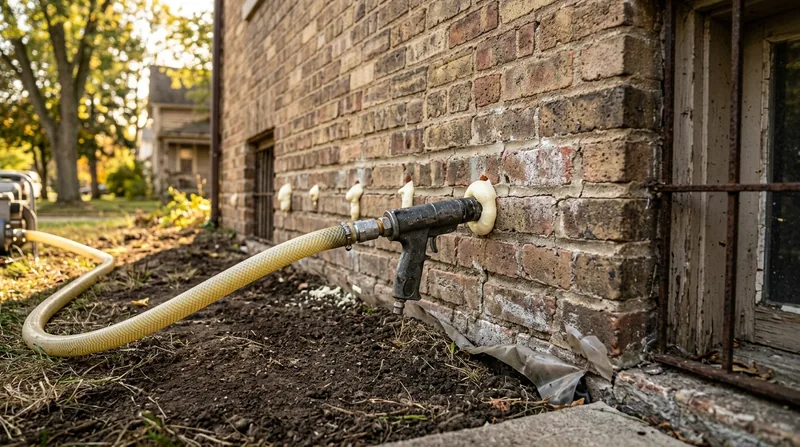




Pre-war homes clustered near downtown Aurora, Batavia, and North Aurora often hide a costly problem: empty wall cavities that have never been insulated. Built before modern insulation standards, these structures lose heat steadily through exterior walls every winter, driving up energy costs and creating cold zones that no amount of attic work can fix. Wall and injection foam insulation fills those cavities without removing siding or plaster, sealing the thermal envelope from the inside. Across Kane and DuPage County neighborhoods, homes built in the 1920s through 1950s sit over full basements with rim joists that already leak, and uninsulated walls that compound the problem. We drill small holes, inject closed cell or open cell foam directly into the wall cavity, and seal it permanently. The result is a warmer home, lower winter bills, and no exterior demolition.
Why Wall and Injection Foam Insulation Matters in Older Aurora Neighborhoods
The Fox Valley's housing stock tells a climate story. Pre-war homes in downtown Aurora and along the river were built when insulation either did not exist or was minimal. Winter temperatures in IECC zone 5A drop well below freezing, and the wind off the Fox River accelerates heat loss through any gap. An uninsulated wall cavity in a 1930s brick colonial loses as much heat as an open window. Mid-century ranches and split-levels added some insulation, but often only in the attic, leaving walls exposed. The result: homeowners feel cold drafts, see uneven heating across rooms, and watch their January heating bills spike. Injection foam reaches places blown-in insulation cannot and creates an air barrier that fiberglass never will.
- Empty wall cavities in pre-1960 homes leak warm air directly to the outside, especially on north and west exposures.
- Injection foam seals the cavity completely, eliminating convection and air infiltration without disturbing plaster, brick, or siding.
- Closed cell foam adds structural rigidity and blocks moisture; open cell is lighter and allows the wall to breathe if vapor management is correct.
- A single-story wall retrofit typically costs less than attic work and delivers immediate comfort gains in the heating season.
Homeowners across Aurora who have retrofitted uninsulated walls report noticeably warmer interiors and measurable heating bill reductions by February. The payback is fastest in homes with large exterior wall area and poor existing insulation.
Key info: Illinois building code governs thermal barrier and ignition barrier requirements for spray foam in walls. The local building department in your city determines whether a thermal barrier is required and how it must be installed. Always check with the city where your home is located before work begins. We help you understand what applies at your address.
For more context on how spray foam fits into a complete energy retrofit, see our air sealing service.
How We Inject Foam Into Walls: The Process in Aurora
Injection foam insulation is a measured, methodical process. We begin with a site visit to assess wall construction, identify cavity boundaries, and confirm there are no obstructions (pipes, wiring, blocked sections). We then drill access holes, typically 1.5 to 2 inches in diameter, spaced 16 to 24 inches apart horizontally and vertically across the wall face. The foam is injected under controlled pressure and metered by weight to fill the cavity completely without overfilling. Once the foam cures (typically 24 to 48 hours depending on foam type and ambient temperature), the holes are patched with foam-compatible caulk and sanded flush. The exterior appearance remains unchanged.
- We drill small access holes in a pattern that ensures complete cavity fill and minimal patching.
- Foam is injected slowly and at the correct pressure to avoid forcing the wall cavity open or damaging the structure.
- The foam expands slightly and hardens, creating a solid, continuous insulation layer with an air barrier.
- Patches are caulked and finished to match the surrounding wall, leaving no visible sign of the work.
- We ventilate the space during cure and observe a 24 to 48 hour re-entry window before the wall is occupied.
The entire process for a typical single-story exterior wall takes one to two days, depending on wall length and cavity complexity. We complete one wall at a time, so you are never displaced from your home.
Local example: A 1940s brick home in North Aurora with a 24-foot north-facing wall and empty cavities requires roughly 150 to 200 board feet of foam, depending on cavity depth. Drilling and injection take 4 to 6 hours. Patches cure overnight. The wall then delivers R-value between 10 and 15, depending on foam type and cavity fill.
Learn more about how closed cell spray foam compares to open cell for wall applications.
Injection Foam Methods and Materials
| Foam Type | Description | Best for Walls |
|---|---|---|
| Closed Cell Injection Foam | High-density, rigid foam with R-value 6 to 7 per inch. Blocks air and moisture. Adds structural strength. | Walls exposed to weather, walls with moisture risk, retrofit of masonry or cavity walls where vapor control matters. |
| Open Cell Injection Foam | Lower-density, softer foam with R-value 3.5 to 4 per inch. Allows vapor transmission. Lower cost per board foot. | Interior walls, cavity walls where moisture drying is beneficial, retrofit where cost is primary driver and vapor is managed. |
| Cavity-Fill Closed Cell (High-Pressure) | Injection-grade closed cell at controlled density. Fills cavities completely. Minimal expansion risk. Thermal barrier required by code. | Retrofit of exterior masonry walls, brick veneer over cavity, older homes with irregular or blocked sections. |
| Two-Part Injection Resin (Polyurethane) | Two-component system mixed at nozzle. Expands to fill voids. Hardens to closed-cell density. Precise metering required. | Retrofit of masonry, historic walls, cavities with obstructions, applications where structural bonding is desired. |
Each method has a specific use case. We assess your wall construction on site and recommend the foam type that delivers the best combination of R-value, vapor management, and cost for your home's climate and location.
Wall and Injection Foam Insulation Cost in Aurora: What to Expect
Wall and injection foam insulation in Aurora typically starts at $2 per square foot of wall area treated, though the final cost depends on several factors. A single-story exterior wall 24 feet long and 8 feet tall (192 square feet) will cost less per square foot than a small, difficult-access wall in a basement or a multi-story wall requiring scaffolding. Cavity depth, wall construction type (brick, block, frame), and the presence of obstructions (pipes, wiring, blocked sections) all affect the total. A closed cell injection costs more per board foot than open cell, but delivers higher R-value and better moisture control, often justifying the premium in older masonry walls.
- Single-story exterior wall retrofit with closed cell foam typically ranges from $500 to $1,500 depending on wall size and access.
- Open cell injection costs 20 to 30 percent less per board foot and suits interior walls or retrofit where vapor transmission is acceptable.
- Masonry walls (brick, block) with empty cavities cost more because cavity fill is slower and foam volume is higher.
- Multiple walls in one job reduce per-square-foot cost because mobilization and setup are shared across the scope.
The best way to know your cost is to call for a free estimate. We measure the wall, assess the cavity, and provide a written quote with R-value and thickness specifications. See our pricing page for more detail on how we structure estimates.
Do not accept a quote without R-value and thickness specs, and do not hire a contractor who cannot explain why their price differs from others. Low-ball estimates often mean shortcuts: no mechanical ventilation during cure, immediate re-entry promised, or no inspection of foam density. We price honestly and stand behind every job.
What to Look for When Hiring a Wall and Injection Foam Insulation Contractor Near Me in Aurora
Hiring a spray foam contractor is a significant decision. The work is permanent, and poor installation shows up months or years later as inadequate R-value, moisture problems, or off-gassing. Always verify that any contractor you hire is fully insured and carries general liability and workers compensation coverage. Request a certificate of insurance and confirm that it is current. Ask for references from recent jobs in your neighborhood or city. Call those references and ask about the quality of the work, the professionalism of the crew, and whether the foam cured properly and the patches held.
- Confirm the contractor is fully insured with current certificates of general liability and workers compensation coverage.
- Ask for a written estimate that includes R-value per inch, foam thickness, total board feet, and the type of foam (closed or open cell).
- Verify that the contractor plans to ventilate the space during cure and will observe a 24 to 48 hour re-entry window before occupancy.
- Check whether the contractor has experience with your home's wall construction type (brick, block, frame, plaster) and can handle obstructions.
- Ask about the warranty on the installation and what it covers, and get it in writing.
- Call the local building department and ask whether a permit is required for wall insulation in your city and whether the contractor is registered to pull it.
Do not choose based on price alone. The cheapest estimate often means the contractor is cutting corners on technique, ventilation, or inspection. The most expensive is not always the best either. A fair price paired with clear communication, full insurance, and a detailed estimate is the marker of a professional contractor you can trust.
Ready to get started? Contact us for a free estimate or call (331) 258-5715. We serve Aurora, Naperville, Joliet, Elgin, and surrounding areas across Kane, DuPage, Kendall, and Will counties.
Wall & Injection Foam Insulation in Aurora: Pricing Guide
| Service | Price | Details |
|---|---|---|
| Single-story exterior wall, closed cell | Starting at $2/sq ft | Wall area, cavity depth, and access determine final cost; masonry walls cost more than frame |
| Open cell injection, interior or retrofit | Starting at $1.50/sq ft | 20 to 30 percent savings over closed cell; best where vapor transmission is acceptable |
| Multi-story or complex wall retrofit | On estimate | Scaffolding, obstructions, or irregular cavity geometry requires on-site assessment before pricing |
| Travel and mobilization | Included | No separate mileage fee within Aurora and surrounding service areas |
| Free written estimate | No cost or obligation | Response within 24 hours; includes R-value, thickness, foam type, and total board feet |
Indicative pricing, the exact cost depends on square footage, finish, and site access. Free personalized estimate within 24h at (331) 258-5715.


