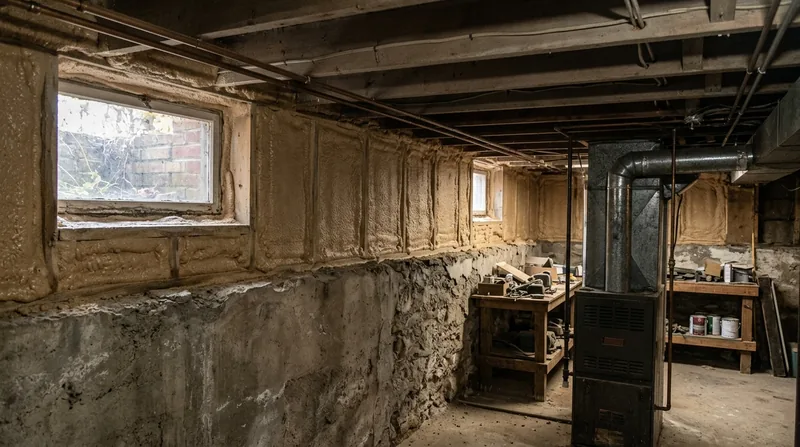




Closed cell spray foam insulation in Aurora seals the damp basement air that rises through rim joists every spring and blocks summer heat gain through walls and attics across Kane, DuPage, Kendall and Will counties. Aurora's housing stock spans pre-war homes along the Fox River with original uninsulated cavities, mid-century ranches with settled fiberglass, and newer two-story construction with complex roof lines and bonus rooms over garages. In IECC climate zone 5A, closed cell foam adds structural rigidity and acts as a vapor retarder where moisture drive flips with the seasons, pushing inward during humid summers and reversing in dry winters. This high-density foam stops air leaks at the source and controls condensation on metal buildings and in crawl spaces where open cell would fail. We measure each job on site, specify R-value and thickness in writing, and spray to manufacturer ratio and temperature so the foam cures properly without off-gassing or thermal barriers that were never there.
Why Closed Cell Spray Foam Matters in Aurora Basements and Rim Joists
Aurora's older neighborhoods sit over full basements where damp air rises through rim joists and band joists every spring and fall. Fiberglass batts in these cavities absorb moisture, lose R-value, and leave cold air leaks that cost hundreds in heating every winter. Closed cell foam blocks that damp air, seals the gaps fiberglass never reached, and dries out as it cures so moisture does not trap inside the wall. In mid-century ranches toward Montgomery and Oswego, garage ceilings and attic rim joists sweat in summer and freeze in winter because the insulation there cannot stop vapor drive. Closed cell foam acts as both insulation and a vapor retarder, so it stops the moisture before it reaches the framing.
- Stops damp basement air from rising through rim joists and band joists in pre-war homes along the Fox River and downtown Aurora.
- Adds structural rigidity to walls and crawl spaces so framing stays stable and does not flex in wind or under load.
- Controls condensation on metal buildings, pole barns and barndominiums where steel sweats without a vapor retarder.
- Blocks air leaks around rim joists in Naperville, Joliet, Elgin and Bolingbrook where energy bills track moisture and infiltration.
- Seals attic rim joists and garage walls so heat does not escape in winter and humid air does not enter in summer.
These are the failure modes that dominate Aurora's energy costs and indoor comfort across all three residential eras.
Key info: Illinois building code requires a thermal barrier between spray foam and occupied space in walls, attics and crawl spaces. The fifteen-minute thermal barrier distinction is governed by the building official at your address in Aurora, Naperville or Plainfield, never by the installer. Always confirm what applies at your property before any foam is sprayed. Contact your local building department or call us at (331) 258-5715 to verify requirements.
How We Spray Closed Cell Foam: Step-by-Step Process in Aurora Homes
We arrive with a written scope that names the R-value, thickness in inches, and board footage we will spray. We inspect the substrate for moisture, active leaks, or contamination and walk away if the surface is wet or compromised. We set up mechanical ventilation before spraying so off-gassing is vented outside during cure. We spray in controlled passes so the foam reaches the specified thickness without over-packing, which causes shrinkage and voids. After spraying, we give you a re-entry window of twenty-four to forty-eight hours so the foam cures fully before you occupy the space. We then trim excess foam flush to the framing and install the required thermal barrier if code calls for one.
- We measure the area on site and calculate board footage so the estimate reflects what you are actually getting.
- We confirm the R-value and thickness in writing before we mix a single drum of foam.
- We run mechanical ventilation during the entire spray and cure window so air quality stays safe inside your home.
- We spray at the manufacturer ratio and drum temperature so the foam rises, cures and hardens without defects.
- We trim and clean up so the job is finished and ready for drywall, electrical or the next trade.
Every job in Aurora, Bolingbrook, Romeoville and Oswego follows the same process so you know what to expect before we start.
Example: A North Aurora basement rim joist retrofit in a 1950s ranch took two days: day one for insulation removal and substrate prep, day two for closed cell foam spray and thermal barrier installation. The homeowner stayed upstairs during cure and re-entered the basement after forty-eight hours. Energy bills dropped during the next heating season and basement humidity stayed steady through summer thunderstorms. That is the outcome we aim for on every job. Learn more about rim joist and band joist spray foam insulation to see if your home qualifies.
Closed Cell Spray Foam Methods and Applications
| Approach | Description | Best for |
|---|---|---|
| Rim and Band Joist Sealing | Closed cell foam sprayed into the cavity between rim joist and foundation wall, sealing air leaks and blocking damp basement air from rising into walls. | Pre-war homes in downtown Aurora and Batavia with uninsulated rim joists and cold basements. |
| Attic Rim and Sealed Roof Deck | Closed cell foam sprayed on the underside of roof sheathing and around attic rim joists to create a conditioned attic assembly that stops heat loss and controls moisture. | Bonus rooms over garages and complex roof lines in newer subdivisions toward Naperville and Kendall County. |
| Crawl Space Insulation and Vapor Control | Closed cell foam sprayed on rim joists, band joists, and foundation walls in crawl spaces to block air leaks and act as a vapor retarder against damp earth. | Homes in Plainfield, Romeoville and Oswego with vented or semi-vented crawl spaces that stay damp after heavy rain. |
| Wall Cavity Retrofit (Injection Foam) | Closed cell foam injected into existing wall cavities without demolition, filling voids and sealing air leaks in pre-1980 construction. | Older Aurora neighborhoods where walls were never insulated and adding exterior insulation is not feasible. |
| Metal Building and Barndominium Condensation Control | Closed cell foam sprayed on the underside of metal roof panels and walls to stop condensation and provide structural insulation on steel framing. | Pole barns, agricultural buildings, and barndominiums in the Fox Valley where steel sweats without a vapor retarder. |
| Garage Ceiling Insulation | Closed cell foam sprayed on the underside of garage ceilings and attic rim joists to stop heat loss and block humid air from entering bonus rooms above. | Two-story homes with heated bonus rooms over garages in Montgomery, Wheaton and North Aurora. |
Closed Cell Spray Foam Insulation Cost in Aurora: What to Expect
Closed cell spray foam starts at approximately $1.20 per board foot in Aurora and surrounding areas, though the final price depends on several site-specific factors. A rim joist retrofit in a 1950s ranch basement might run $1,200 to $2,000 depending on linear footage and access. An attic rim joist and sealed roof deck on a newer two-story home with a complex roof line can run $3,500 to $8,000 because the square footage is larger and the work is more labor-intensive. A full crawl space with closed cell foam applied to rim joists, band joists and foundation walls typically costs $2,000 to $5,000 depending on the size and whether old insulation must be removed first. Metal building or pole barn condensation control on steel framing runs by the square foot of surface area and can be significantly higher because the scope is usually large.
The factors that move cost up or down are: the size of the area being sprayed, whether old insulation must be removed first, the complexity of the roof line or framing, and access difficulty in tight crawl spaces or around obstacles. If your basement rim joist is blocked by finished walls or storage, we may need to remove drywall or move items before we can spray, which adds labor. If your attic has settled fiberglass that must come out before foam goes in, that adds a separate removal phase and cost. We always give you a written estimate with R-value and thickness so you know exactly what you are paying for before any work starts.
Get a free estimate by calling (331) 258-5715 or submitting a request online. We respond within twenty-four hours with no obligation to book. If you want a detailed pricing breakdown for your specific area, see our full pricing overview.
What to Look for When Hiring a Closed Cell Spray Foam Contractor Near Aurora
Hiring the right spray foam insulation contractor matters because bad technique shows up months or years later as off-gassing smell, incomplete coverage, or foam that shrinks away from the framing. The trade has rig-and-run crews that spray a job in an afternoon and disappear, national franchises that follow corporate templates instead of local code, and local independents who stand behind the work and stay reachable if something goes wrong. When you call a contractor, ask for a written estimate with R-value and thickness specified, not a vague price per square foot. Ask whether they run mechanical ventilation during cure and what re-entry window they recommend. Ask for references from recent jobs in Aurora, Naperville or Bolingbrook so you can verify the outcome.
- Verify that the contractor is fully insured and ask to see a current certificate of insurance naming you as additional insured.
- Get written estimates from at least two contractors so you can compare R-value, thickness, and price in the same terms.
- Ask whether permits are required at your address and whether the contractor helps you navigate local code or leaves that to you.
- Check online reviews and ask for contact information from homeowners so you can call them and ask about the quality of the work and the contractor's responsiveness afterward.
- Confirm that the estimate includes mechanical ventilation during spray and cure, and that the re-entry window is stated clearly in writing.
- If your home is in an HOA or a historic district, ask whether the contractor is familiar with architectural review or local approval processes.
The strongest signal of a good spray foam contractor is honesty about what the job will cost and why. If an estimate is far below market with no detail and no inspection, that is a warning sign. If a contractor promises immediate re-entry or makes absolute safety claims, that is another red flag. The correct position is that closed cell foam is low-VOC once cured, requires controlled application at the right ratio and temperature, and needs mechanical ventilation during the spray and cure window so air quality stays safe. That expertise, combined with responsiveness and a willingness to answer questions, is what separates a contractor worth hiring from one that cuts corners. Contact us for a free estimate and see the difference a local, experienced contractor makes.
Closed Cell Spray Foam Insulation in Aurora: Pricing Guide
| Service | Price | Details |
|---|---|---|
| Rim Joist and Band Joist Sealing | Starting at $1.20/board ft | Closed cell foam sprayed into rim joist cavities; cost varies by linear footage and basement access difficulty |
| Attic Rim Joist and Sealed Roof Deck | Starting at $1.20/board ft | Closed cell foam on roof underside and rim joists; price depends on roof complexity and whether old insulation requires removal |
| Crawl Space Insulation | Starting at $1.20/board ft | Closed cell foam on rim joists, band joists and foundation walls; total cost scales with crawl space size and moisture remediation needs |
| Wall Cavity Retrofit (Injection Foam) | Starting at $1.20/board ft | Closed cell foam injected into existing wall cavities without demolition; cost depends on cavity accessibility and wall length |
| Metal Building or Pole Barn | On estimate | Closed cell foam on metal roof and walls for condensation control; large square footage and steel framing require on-site measurement |
| Free Estimate and Consultation | Free | Written scope with R-value and thickness; response within 24 hours at (331) 258-5715, no obligation to book |
Indicative pricing, the exact cost depends on square footage, finish, and site access. Free personalized estimate within 24h at (331) 258-5715.


