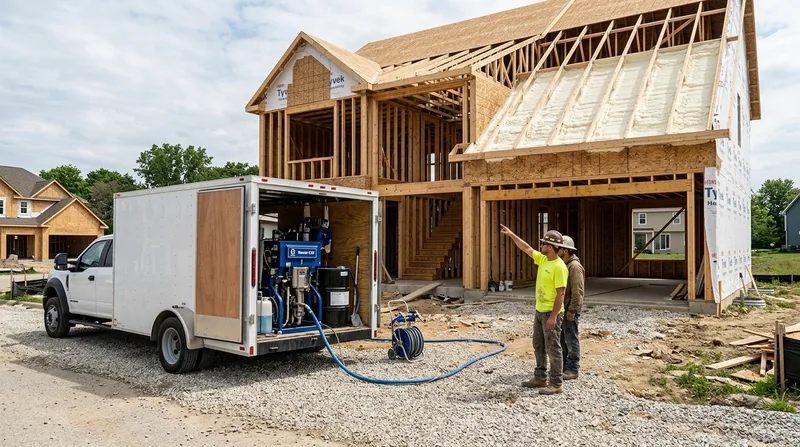




Commercial & New Construction Spray Foam in Aurora gets specified before drywall closes in on new builds across Kane, DuPage, Kendall and Will counties. Builders working the subdivisions toward Naperville, Oswego and the newer two-story stock pushing south into Plainfield and Romeoville need attic assemblies, wall cavities, rim joists and garage ceilings insulated to code before framing gets covered. Aurora's climate is IECC zone 5A: cold winters with real snow load, hot humid summers, and vapor drive that reverses with the seasons. Unvented attics and complex roof lines over bonus rooms demand closed cell spray foam or hybrid approaches specified in advance. Getting it right the first time means no callbacks, no moisture trouble, and energy performance that tracks the builder's promises to the buyer.
Why New Construction Spray Foam Matters in Aurora's Building Season
New construction in Aurora and the surrounding Fox Valley follows a tight schedule. Framing goes up fast, and once drywall is hung, insulation access is gone. Spray foam has to be on the schedule before the drywaller arrives, and the specification has to match the building code in force at that address. Closed cell foam delivers the R-value per inch that tight attics and bonus room ceilings need, and it also seals the air leaks that fiberglass cannot touch. Open cell foam works for walls and standard attics where cost matters more than vapor control. Either way, the installer has to understand the difference between a sealed roof deck assembly and a vented attic, and why the thermal barrier requirement is not negotiable.
- Closed cell foam delivers up to R-7 per inch, critical for compact attics and garage ceilings where headroom is tight.
- Open cell foam runs R-3.5 to R-3.8 per inch and costs less, suitable for standard walls and attics in new construction where thickness is not a constraint.
- Air sealing around electrical boxes, rim joists and band joists stops the cold air leaks that fiberglass leaves behind.
- Mechanical ventilation during cure and a stated re-entry window of 24 to 48 hours are non-negotiable for health and safety on occupied or soon-to-be-occupied sites.
- Written estimates must specify R-value, thickness and foam type so the builder can verify compliance with the energy code and the architect's design.
Getting the insulation right in new construction sets the foundation for the home's energy performance and eliminates the most common source of callbacks and warranty claims on new builds.
Key info: Aurora's newer subdivisions toward Naperville and Oswego often include bonus rooms over garages and complex roof lines with unvented attic assemblies. These require closed cell spray foam specified before framing closes. A builder in North Aurora working a two-story with a bonus room over an attached garage needs the attic and garage ceiling foamed before drywall hangs, or the job gets delayed and the schedule breaks.
For detailed building code requirements in your jurisdiction, consult the City of Aurora Building Department. Permitting and code compliance vary by city across Greater Aurora, and the building official at your address has final authority on thermal barrier requirements, ignition barriers and ventilation.
How We Work with Builders on New Construction Spray Foam in Aurora
Our process starts with the architect's or builder's specification sheet. We review the energy code requirements for the site, confirm the foam type and R-value target, and provide a written estimate with thickness and board footage. On the day of the spray, we set up mechanical ventilation, control the substrate temperature and drum temperature, and apply foam in passes that meet the manufacturer's specifications. We leave the site in a condition safe for other trades to work, and we provide documentation of the work for the builder's compliance file.
- Receive the specification from the builder or general contractor, including foam type, R-value target and areas to be foamed.
- Conduct an on-site walk to confirm substrate condition, access and any site-specific constraints like occupied spaces or tight timelines.
- Provide a written estimate with R-value, thickness, board footage and pricing, delivered within 24 hours.
- Schedule the spray date to fit the builder's framing and drywall timeline, with confirmation 48 hours in advance.
- Set up mechanical ventilation and establish a safe re-entry window of 24 to 48 hours after cure.
- Provide written documentation of the work for the builder's compliance and warranty file.
This sequence keeps the builder on schedule and gives the new homeowner confidence that the insulation was installed to code and specification.
Example: A builder in Oswego framing a 12-lot subdivision with two-story colonials and bonus rooms over garages needed closed cell foam in all attics and garage ceilings before drywall. We provided estimates for each lot type, confirmed the R-value and thickness for the local energy code, and coordinated spray dates around the builder's framing schedule. Each home was foamed, documented and ready for drywall the next day.
Learn more about our closed cell spray foam insulation and how it performs in new construction applications across the Fox Valley.
Spray Foam Methods for New Construction in Aurora
| Approach | Description | Best for |
|---|---|---|
| Closed Cell Spray Foam | High-density foam delivering R-7 per inch, vapor-impermeable, excellent air seal and structural rigidity. | Attics with tight headroom, unvented roof decks, bonus rooms, garage ceilings, metal buildings and rim joists in new construction. |
| Open Cell Spray Foam | Lower-density foam delivering R-3.5 to R-3.8 per inch, vapor-permeable, cost-effective and suitable for vented attics and interior walls. | Standard attics, interior wall cavities, sound dampening and new construction where cost control is a priority and thickness is available. |
| Hybrid Approach | Closed cell in critical zones (rim joist, band joist, garage ceiling) and open cell in standard attic cavities to balance performance and cost. | Two-story new construction with complex roof lines, bonus rooms and varying insulation requirements across different building sections. |
| Air Sealing with Foam | Spray foam applied around electrical boxes, HVAC penetrations, band joists and rim joists to eliminate air leaks before drywall closes. | All new construction to achieve blower door targets and meet energy code air leakage limits before the home is occupied. |
Commercial & New Construction Spray Foam Cost in Aurora: What to Expect
Pricing for new construction spray foam depends on the foam type, the R-value target, the area to be foamed and site access. Closed cell foam costs more per board foot than open cell, but delivers higher R-value per inch and is often required for tight spaces or unvented assemblies. A builder working multiple lots can lock in a per-board-foot rate or a per-lot pricing structure. Start with a free commercial estimate that includes a walk of the framing, a review of the specification and a written quote with board footage and total cost.
The biggest cost drivers are the foam type (closed cell versus open cell), the total square footage of attic and wall cavity, and the R-value target set by the energy code at that address. A compact attic with a 6-12 pitch and bonus room over a garage will need more closed cell per square foot than a standard 4-12 attic. Site access, weather delays and the builder's schedule can also affect pricing. Getting 2 to 3 estimates from different installers is smart; compare the R-value and thickness, not just the total price.
For a detailed breakdown of pricing factors and typical ranges, visit our pricing page. Call us at (331) 258-5715 for a free commercial estimate with no obligation to book.
What to Look for When Hiring a Spray Foam Insulation Contractor Near Aurora
Choosing the right spray foam installer for new construction is critical because the work happens before drywall, and mistakes are expensive to fix. A good contractor will provide a written estimate with R-value and thickness specifications, explain the difference between closed cell and open cell foam, and confirm that the work meets the local energy code. The contractor should also carry full insurance, provide references from recent new construction projects and be reachable if questions arise after the spray.
- Verify that the contractor is fully insured and can provide a certificate of insurance naming your builder as an additional insured.
- Ask for written estimates that specify R-value, thickness, foam type and total board footage so you can compare apples to apples.
- Check references from recent new construction projects in Aurora, Naperville, Oswego or nearby subdivisions.
- Confirm that the contractor understands the local energy code and the thermal barrier and ignition barrier requirements at your address.
- Ask about mechanical ventilation during cure and the stated re-entry window so the builder can schedule other trades accordingly.
- Ensure the contractor provides written documentation of the work for your compliance file and the new homeowner's warranty records.
A local contractor with experience on new construction projects in the Fox Valley will understand the builder's schedule, the local code and the quality standard that keeps callbacks and warranty claims to a minimum.
Ready to get started? Contact us for a free commercial estimate and to discuss your new construction spray foam needs.
Commercial & New Construction Spray Foam in Aurora: Pricing Guide
| Service | Price | Details |
|---|---|---|
| Free Commercial Estimate | Free | On-site walk, specification review, written quote with R-value, thickness and board footage included |
| Closed Cell Spray Foam | Starting at $1.50-$2.25 per board foot | Higher R-value per inch, vapor barrier, suitable for attics, garage ceilings and unvented assemblies |
| Open Cell Spray Foam | Starting at $0.90-$1.40 per board foot | Lower cost, suitable for standard walls and vented attics where thickness is not constrained |
| Hybrid Approach (Closed & Open Cell) | On estimate | Closed cell in critical zones, open cell in standard areas; pricing depends on allocation and total square footage |
| Travel & Scheduling | Included | No separate mileage fee or call-out charge for Aurora and surrounding service areas within Kane and DuPage counties |
| Documentation & Compliance | Included | Written documentation of work, R-value and thickness for builder's compliance file and new homeowner warranty records |
Indicative pricing, the exact cost depends on square footage, finish, and site access. Free personalized estimate within 24h at (331) 258-5715.


