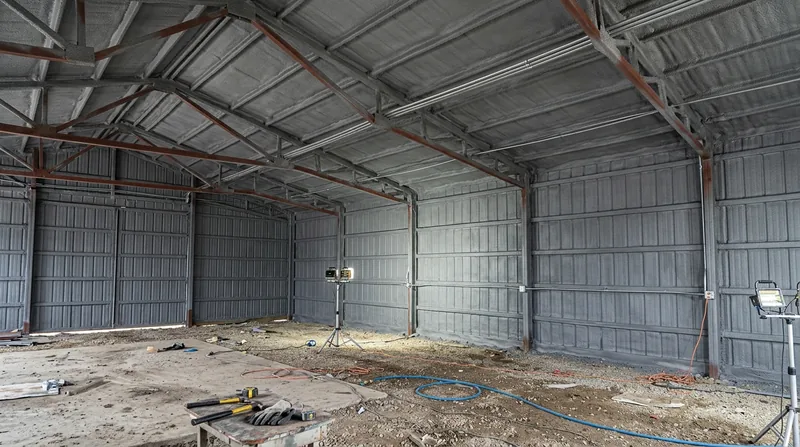




Metal shops, pole barns, and newly built barndominiums across Kane and Kendall counties face a relentless problem every summer: interior metal skins sweat under humid Fox Valley air, and that condensation eats into stored equipment, corrodes fasteners, and breeds rust from the inside out. Winter brings the opposite failure: uninsulated metal radiates cold through zone 5A's windy nights, and the interior temperature swings so wide that condensation forms on the underside no matter the outdoor humidity. Metal building and barndominium spray foam insulation in Aurora stops both modes at once. Closed cell foam adheres directly to the interior metal surface, creates an air barrier that eliminates thermal bridging, and prevents the temperature differential that triggers condensation. We have been doing this work since 2011 across Aurora, Naperville, Joliet, and the surrounding Fox Valley, and we know the exact thickness and R-value needed to hold back the moisture and the cold in this climate.
Why Condensation Control Matters for Metal Buildings Near Aurora
A metal building with no interior insulation is essentially a radiator in winter and a sweat lodge in summer. The steel frame conducts temperature from outside straight through to the interior, and when warm, humid air (especially during Fox Valley thunderstorms or after a heat wave) hits that cold metal, water condenses on the surface. That moisture collects in corners, pools on equipment, and accelerates corrosion of any fastener or weld. Spray foam stops that cycle by breaking the thermal bridge and creating a vapor-resistant layer that prevents moisture from reaching the metal skin in the first place.
- Closed cell foam bonds directly to metal and resists vapor drive in both directions, controlling humidity year-round.
- The foam's rigidity adds minor structural bracing to the metal frame and improves racking resistance in high-wind zones.
- A properly sprayed interior skin eliminates the need for ventilation louvers or dehumidifiers, cutting ongoing operating costs.
- The air seal created by foam stops infiltration of dust, pollen, and insects that would otherwise settle on stored goods or equipment.
Once the condensation stops, the building holds temperature and humidity in a stable band, which extends the life of anything stored inside and cuts the load on any climate control system you install later.
Key info: A metal shop in North Aurora that stored fabrication tools and parts lost two seasons of inventory to rust and corrosion before spray foam was applied to the interior roof and walls. After foam, interior humidity stayed between 45 and 55 percent year-round, and no new rust appeared in the next three years. The payback came in equipment life alone.
The Kane County Building Department does not regulate insulation thickness or R-value directly, but the energy code in force at your address (usually the current Illinois Energy Conservation Code) sets a minimum R-value for building envelopes. We help you understand what applies at your specific location and deliver a written estimate that names the R-value and thickness we will achieve.
How We Spray Metal Buildings and Barndominiums in Aurora: The Process
Metal building spray foam is a precision job. We start by inspecting the interior surface for rust, standing water, leaks, or contamination. If the substrate is wet or compromised, we fix the moisture first or we walk away, because foam will not bond to a damp or failing surface and you will have a problem later. Once the substrate is clean and dry, we set up mechanical ventilation to pull fumes out during and after the spray, and we establish a re-entry window of 24 to 48 hours depending on ambient temperature and humidity. The actual spray happens in passes, each one a precise thickness, using the correct drum temperature and manufacturer ratio to ensure the foam rises, cures, and reaches its rated R-value.
- We inspect the interior metal surface and identify any rust, leaks, or moisture that must be addressed before spray begins.
- We set up containment and mechanical ventilation to manage fumes and ensure safe conditions during cure.
- We spray the foam in controlled passes, monitoring thickness and rise to achieve the R-value specified in your written estimate.
- We allow the full cure window (24 to 48 hours) before you re-enter, and we provide clear guidance on re-entry timing.
- We deliver a final inspection report with photographs and the actual R-value and thickness achieved on your building.
The whole process from substrate prep to final cure typically takes three to five days on a medium-sized metal building, depending on square footage and the number of passes required.
Local example: A 6,000-square-foot pole barn in Oswego used for equipment storage needed 4 inches of closed cell foam to reach R-24, the minimum for that climate zone and use. We sprayed the roof deck and upper 8 feet of walls over four days, with mechanical ventilation running the entire time. The owner re-entered 48 hours after the final pass and saw no condensation on the metal for the first time in five years.
For details on how we handle closed cell spray foam insulation and the technical specs behind it, see our closed cell page. If you have an existing metal building with failed or incomplete insulation, our insulation removal service prepares the substrate and removes old material before new foam is applied.
Metal Building Spray Foam Methods: Closed Cell vs. Open Cell
| Approach | Description | Best for |
|---|---|---|
| Closed Cell Spray Foam | High-density foam (3.5 to 3.6 lb/cu ft) that bonds hard to metal, resists vapor, and reaches R-6 to R-7 per inch. Requires 3 to 4 inches for R-24 in zone 5A. | Metal buildings, pole barns, and barndominiums where condensation control and vapor resistance are critical. The standard for this application. |
| Open Cell Spray Foam | Lower-density foam (0.5 to 0.6 lb/cu ft) that is vapor-permeable, reaches R-3.5 per inch, and requires 6 to 7 inches for R-24. Cheaper per board foot but demands a separate vapor barrier. | Interior walls or attic spaces where vapor permeability is desired and condensation is not the dominant failure mode. Rarely the right choice for metal buildings in this climate. |
| Closed Cell on Roof Deck, Open Cell on Walls | A hybrid approach: closed cell on the roof to stop condensation from summer heat and humidity, open cell on interior walls for cost savings and sound dampening. | Barndominiums or shops where the roof is the primary moisture risk and wall insulation is secondary. Requires careful vapor management and is not common. |
| Partial Coverage (Roof Only or Walls Only) | Spray foam applied to the roof deck alone or to walls only, leaving the remaining surfaces uninsulated or with blown-in fiberglass as a cost compromise. | Budget-constrained jobs where condensation on one surface is the immediate problem. Not a long-term solution but buys time and cuts the worst leaks. |
For metal buildings in zone 5A, closed cell is the default choice. It stops condensation, it bonds to the metal, and it delivers the R-value you need in a thickness that does not consume floor space. Open cell is cheaper per board foot but requires more thickness and a separate vapor barrier, which adds cost and complexity on a metal substrate where condensation is the real threat.
Metal Building and Barndominium Spray Foam Cost in Aurora: What to Expect
Metal building spray foam pricing starts at $1.75 per square foot for a straightforward closed cell application on a roof deck or simple wall surface. That baseline assumes a clean, dry substrate, good access for the spray rig, and a job large enough to justify the setup cost (typically 1,000 square feet or more). From there, the price moves based on the actual conditions you have on site.
Factors that push cost up include rust or corrosion that must be cleaned or prepped before spray, standing water or moisture that requires drying time, complex geometry (scissor trusses, peaked roofs, or irregular wall lines) that requires more careful spraying, and small total square footage that spreads the mobilization cost over fewer square feet. A 2,000-square-foot metal shop roof with a simple gable will cost less per square foot than a 800-square-foot shop with multiple gable peaks and interior posts.
Access also matters. If the spray rig can pull up near the building and set up equipment inside or immediately adjacent, the job moves faster. If the building is in a dense commercial area or on a lot with tight site constraints, we may need to hand-carry equipment or use smaller rigs, which adds labor and time.
The best way to know your actual cost is to call us for a free, no-obligation estimate. We will visit your site, measure the square footage, inspect the substrate, and deliver a written quote with the R-value and thickness you will receive. We respond within 24 hours at (331) 258-5715. See our full pricing page for more detail on how we structure estimates and what factors move the number.
What to Look for When Hiring a Metal Building Spray Foam Contractor Near Me in Aurora
The spray foam trade has two extremes: rig-and-run crews that show up in an out-of-state trailer, spray a job in an afternoon with no ventilation, and disappear when the smell will not fade, and national franchises that send a different crew each time and have no local accountability. A local independent contractor with a local address and local plates is positioned to stand behind the work and be there when questions arise after cure.
When you are comparing spray foam contractors, look for these marks of competence and honesty:
- The contractor provides a written estimate that names the R-value and thickness you will receive, not just a price per square foot.
- The contractor sets up mechanical ventilation during spray and names a specific re-entry window (24 to 48 hours), not "immediate occupancy."
- The contractor inspects the substrate and will refuse the job if moisture or contamination is present, rather than spraying over wet or failing surfaces.
- The contractor carries full insurance and provides a certificate of insurance on request, and will not claim to be licensed or bonded if the licensing regime in your city does not apply to spray foam work.
- The contractor gives you references from recent jobs and is willing to let you call them and ask questions.
- The contractor explains the difference between closed cell and open cell and recommends one based on your actual failure mode, not the one with the highest margin.
Ask any contractor you are considering to walk you through their process: how they prep the substrate, what ventilation they use, how they monitor thickness and rise, and what your re-entry timeline will be. A contractor who can answer these questions in detail and explain the reasoning is one who knows the trade. One who gives a price, a date, and a promise of "no smell" is one to skip.
If your metal building is in a master-planned community or subject to HOA rules, check the architectural guidelines before you book the work. Most HOA restrictions focus on exterior appearance and do not touch interior insulation, but it is worth confirming. If your building is on a lot that requires a building permit for energy code compliance, the local building department will review the R-value and thickness in our estimate. Your local building department can tell you what applies at your address and work with the building department if a permit is required.
Ready to get started? Contact us today for a free estimate, or call (331) 258-5715.
Metal Building & Barndominium Spray Foam in Aurora: Pricing Guide
| Service | Price | Details |
|---|---|---|
| Closed Cell Spray Foam (Metal Buildings & Barndominiums) | Starting at $1.75/sq ft | Includes substrate inspection, setup, controlled-pass spray, and full cure monitoring. Price rises with rust prep, moisture remediation, or complex geometry |
| Roof Deck Coverage (Full Insulation) | Starting at $1.75/sq ft | Typically 3 to 4 inches of closed cell to reach R-24 in zone 5A. Includes ventilation during cure and 24 to 48 hour re-entry window |
| Wall Coverage (Full Height or Partial) | Starting at $1.75/sq ft | Same closed cell application as roof, scaled to wall square footage. Partial coverage (upper 8 feet only) reduces total cost proportionally |
| Substrate Prep (Rust Cleaning, Drying, or Moisture Remediation) | On estimate | Wet substrates or corroded surfaces require prep work before spray. We assess on site and quote separately to isolate the true foam cost |
| Small Jobs or Complex Access | On estimate | Jobs under 1,000 square feet or those with tight site access may carry higher per-square-foot cost due to mobilization and labor concentration |
| Free Estimate & Site Visit | Free | Response within 24 hours at (331) 258-5715. Written quote with R-value and thickness specs. No obligation to book |
Indicative pricing, the exact cost depends on square footage, finish, and site access. Free personalized estimate within 24h at (331) 258-5715.


