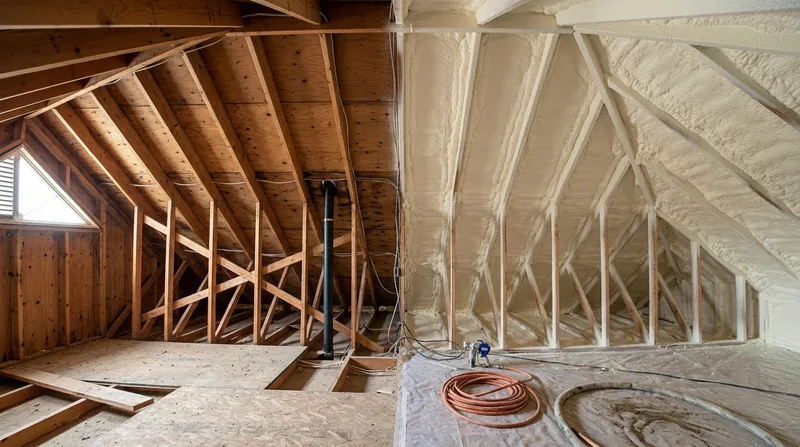




Insulation Replacement & Re-Insulation in Aurora is the most direct way to reset an attic or crawl space that has failed under decades of Illinois weather. Pre-war homes along the Fox River and mid-century ranches across Kane and DuPage counties carry settled fiberglass, compressed foam, or bare rim joists that no longer hold back the cold winters and humid summers that define IECC climate zone 5A. Newer subdivisions south toward Kendall County face their own problems: unvented attic assemblies with moisture drive that pushes inward during summer thunderstorms and outward during dry winters, plus garage ceilings and bonus rooms that were never properly insulated in the first place. Pulling failed material, air sealing the penetrations that leak, and spraying new foam sized for your home's actual exposure resets the thermal and moisture boundary. We help Aurora homeowners, from downtown to Oswego, move from energy loss and humidity swings to stable conditions and lower bills. Call us at (331) 258-5715 for a free, written estimate with R-value and thickness specs, or learn more about our attic spray foam insulation work.
Why Insulation Replacement Matters in Aurora's Humid Summers and Cold Winters
Old insulation fails in two ways in Aurora. Fiberglass settles and compacts over twenty to thirty years, dropping from an R-value of R-3.5 per inch to R-2 or less, especially in attics where foot traffic, rodent nests, or moisture exposure speed the decay. Closed cell foam installed without proper ventilation during cure, or over a wet substrate, can trap moisture and degrade from the inside. Rim joists and basement walls in full-basement homes collect condensation in summer and lose heat in winter because they were never air sealed or insulated in the first place. The result is energy waste, hot upper floors in July, cold bedrooms in January, and moisture swings that stress HVAC equipment and invite mold growth on wood framing.
- Settled fiberglass loses R-value and allows air leakage through gaps and compression zones.
- Failed foam installations trap moisture or separate from framing, leaving thermal bridges.
- Rim joists and band joists in basements leak cold air directly into living spaces above.
- Unvented attics with moisture drive require complete re-insulation to manage vapor correctly.
- Crawl spaces with old batts or no insulation drive humidity up through floors and into the home.
Replacing insulation with new spray foam and air sealing the gaps and penetrations stops these failures at the source.
Key info: Attic ventilation rules, thermal barrier requirements, and ignition barriers are governed by the energy and building code in force at your address in Aurora, North Aurora, Naperville, or Oswego. Always verify what applies to your home with your local building department before starting work. We follow code, but you and your builder are responsible for confirming the rules at your site.
For more on the rules that apply to spray foam in attics, check the City of Chicago Department of Buildings or your local Aurora, Kane County, or DuPage County building department website.
How We Handle Insulation Replacement and Re-Insulation in Aurora Homes
Replacement work starts with removal. We pull old fiberglass, cellulose, or failed foam by hand and with equipment, bag it for disposal, and vacuum out dust and debris. Once the cavity is bare, we inspect for air leaks, moisture damage, or active roof or plumbing leaks. If we find water intrusion, we stop and refer you to the contractor who can fix the leak first. Only on a dry, sound substrate do we proceed to air sealing and foam application. We spray new foam in thin, controlled passes, maintain the manufacturer ratio and drum temperature, and run mechanical ventilation during the cure window. Re-entry is typically twenty-four to forty-eight hours after the last pass. We provide a written estimate with R-value, thickness, and square footage before we start, so you know exactly what you are paying for.
- We inspect the cavity for active leaks, moisture, or contamination and refer water work if needed.
- We remove all failed insulation, debris, and dust, and dispose of material responsibly.
- We air seal rim joists, band joists, rim board penetrations, and other gaps with closed cell foam or caulk.
- We spray new foam to the thickness and R-value required by code and your home's exposure.
- We run fans during cure to manage VOCs and moisture, and post a re-entry window for your safety.
- We conduct a final inspection and provide documentation of R-value, thickness, and board footage.
This step-by-step approach ensures the new insulation performs and lasts.
Real example: A 1950s ranch in Bolingbrook with a 1,200-square-foot attic had R-11 fiberglass that had settled to R-6. We removed it, air sealed the rim board and three plumbing penetrations with closed cell, and sprayed R-38 open cell foam in two passes over four hours. Total cure time was thirty-six hours. The homeowner saw a 22 percent drop in summer cooling costs and eliminated the hot upper floor that had plagued them every July.
Learn more about our closed cell spray foam and open cell spray foam options to understand which is right for your job.
Methods and Materials for Insulation Replacement in Aurora
| Approach | Description | Best for |
|---|---|---|
| Open Cell Spray Foam | Low-density foam that expands to fill cavities, allows drying, and is easier to trim and cut after cure. | Attics in existing homes, bonus rooms, and garages where condensation risk is low and cost matters. |
| Closed Cell Spray Foam | High-density foam that creates an air and vapor barrier, resists moisture, and provides higher R-value per inch. | Rim joists, basements, crawl spaces, unvented attics, and metal buildings where moisture control is critical. |
| Blown-In Cellulose or Fiberglass | Dense-packed insulation blown into cavities; lower cost and good air sealing if installed correctly. | Attics with sound structure and no moisture issues, as a top-up on existing insulation. |
| Injection Foam in Walls | Low-pressure foam injected into closed wall cavities without demolition; retrofits pre-1980 homes efficiently. | Pre-war homes in downtown Aurora and mid-century ranches with uninsulated exterior walls and no interior access. |
Insulation Replacement & Re-Insulation Cost in Aurora: What to Expect
Replacement work typically starts at $2,800 for a small attic or crawl space, but the final cost depends on several real factors. The size of the space (square footage), the depth and R-value required by code or your home's exposure, the amount of old material to remove and dispose of, and the number of air sealing details (rim joists, penetrations, ductwork) all move the price. Difficult access, contaminated material that requires special handling, or a wet substrate that needs drying or repair will increase the scope and cost. Most homes in Aurora range from $3,500 to $8,000 for a full attic replacement, and $1,500 to $3,500 for rim joist and basement wall work. We provide a free written estimate with R-value, thickness, and square footage so you know what you are paying for before we spray.
Getting two or three estimates from local contractors is always smart. Compare the R-value and thickness specs, not just the price. A low bid with no detail is a red flag. Make sure the estimate includes removal and disposal, air sealing, and the final inspection. Ask about the re-entry window and any warranty on the installation. Once you have chosen a contractor, confirm that they are fully insured and can provide a certificate of insurance.
What to Look for When Hiring an Insulation Contractor Near Me in Aurora
Hiring the right spray foam contractor is a choice between three types: the national franchise with a trailer that rolls through town and leaves you with no local recourse if the smell or performance is wrong; the rig-and-run crew from out of state that quotes low and disappears after the job; and the local independent with a local address, local insurance, and a reputation to protect. We are the third kind. When you are evaluating any contractor, including us, ask for proof of current insurance, references from homes in your neighborhood, and a written estimate with R-value and thickness. Understand what permits your city requires (attic ventilation, thermal barriers, and ignition barriers vary by code and by address), and confirm that your contractor will help you navigate what applies. If you have an HOA, check whether exterior or garage work requires architectural approval. Never hire based on price alone, and never accept a promise of immediate re-entry or a vague estimate with no R-value specs.
- Verify that the contractor is fully insured and ask to see the certificate before work starts.
- Request written references from three homes in Aurora, Naperville, or nearby, and call them.
- Get a detailed estimate that names the R-value, thickness, square footage, and removal costs separately.
- Confirm what permits your local building department requires and who is responsible for pulling them.
- Ask about the re-entry window and any workmanship warranty, typically one to three years.
- Check whether your HOA requires approval for exterior or garage work before you book.
A contractor who can answer these questions clearly and provide documentation is the one to hire.
Ready to move forward? Contact us at (331) 258-5715 for a free estimate, or visit our insulation removal page to learn more about how we prepare your home for new insulation.
Insulation Replacement & Re-Insulation in Aurora: Pricing Guide
| Service | Price | Details |
|---|---|---|
| Attic replacement, small to medium (up to 1,200 sq ft) | Starting at $3,200 | Removal, air sealing rim board, spray R-38 to R-49 open cell foam, mechanical ventilation during cure |
| Crawl space or basement rim joist replacement | Starting at $1,800 | Removal of old batts, closed cell spray foam on rim board and band joist, vapor barrier inspection and repair |
| Unvented attic with moisture issues or sealed roof deck | Starting at $4,500 | Full removal, substrate inspection and drying, closed cell foam spray to code, thermal barrier and ignition barrier installation |
| Wall injection foam retrofit (pre-1980 homes) | Starting at $2,200 | Cavity drilling and injection, low-pressure foam fill, patch and paint, typical for 800 to 1,200 linear feet of wall |
| Complex or large-scale job (multi-zone, contaminated material, extensive air sealing) | On estimate | Site inspection required to assess removal complexity, substrate condition, and air sealing scope before pricing |
| Travel and estimate | Included in Aurora area | Free written estimate within 24 hours, no obligation to book, (331) 258-5715 |
Indicative pricing, the exact cost depends on square footage, finish, and site access. Free personalized estimate within 24h at (331) 258-5715.


