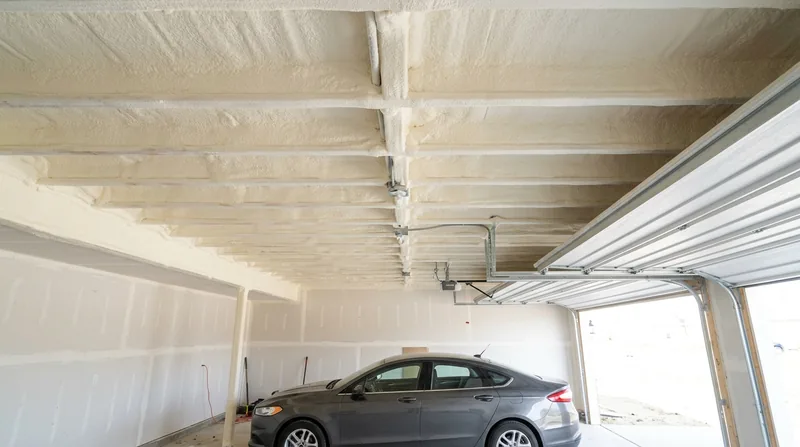




Detached and attached garages across Aurora, Naperville, Joliet and the surrounding Fox Valley take the full force of cold winter wind and summer heat. A garage ceiling with no insulation bleeds heat in January and lets solar gain bake the space in July, which means any room above stays uncomfortable and energy bills climb whether the garage is conditioned or not. Garage spray foam insulation in Aurora stops that loss. We foam the ceiling and walls so bonus rooms overhead stay livable year round, and garages themselves hold steadier temperatures whether you use them for storage, a workshop, or a second living space. Spray foam air-seals as it insulates, so cold drafts stop and moisture control improves. This is climate zone 5A work: real winter cold, real summer heat, and real money saved when the envelope is tight.
Why Garage Spray Foam Insulation Matters in Aurora's Climate
Aurora's housing stock spans three eras across Kane, DuPage, Kendall and Will counties. Mid-century ranches and split-levels dominate many neighborhoods, and many of these homes have bonus rooms, finished spaces, or second-story additions built over uninsulated garages. The garage ceiling becomes a thermal bridge in winter and a heat sink in summer. Older fiberglass batts settle and thin over decades. Blown-in cellulose compacts. Garage walls that face north or west take wind-driven rain and long cold winters. Winter temperatures in Aurora drop to 10 degrees Fahrenheit, and the garage ceiling is often the weakest link in the thermal envelope of the entire home.
- An uninsulated garage ceiling lets heated air escape in winter and allows solar heat to radiate into the space in summer, driving up HVAC runtime upstairs.
- Spray foam seals air leaks around rim joists, rim boards, and the perimeter of the garage where the framing meets the foundation.
- Closed-cell foam provides R-value and acts as a vapor barrier in one pass, which matters in high-humidity summers when moisture moves into the attic.
- Open-cell foam offers lower cost per R-value and works well for garage ceilings where condensation risk is low and sound dampening is a bonus.
- Foam adheres to wood, metal, and concrete, so it fills irregular joist spacing and bridged cavities that batts and blown-in cannot reach.
The result is a garage that stays closer to outdoor temperature in winter (reducing ice dams and cold-weather damage) and cooler in summer, plus any room above becomes genuinely usable and comfortable.
Key info: Aurora's building code (adopted from the Illinois Energy Code) requires attic ventilation in most vented attics and specifies thermal and ignition barriers for spray foam. Garage ceilings that sit below living space must meet the fifteen-minute thermal barrier rule. Always check with your local Aurora building department before starting any insulation work, as requirements vary by address and jurisdiction within Kane and DuPage counties.
How We Spray Foam a Garage Ceiling and Walls in Aurora
Our process starts with a site visit to measure the garage, check for moisture, existing insulation, and any structural issues that need attention first. We identify the substrate (wood joists, concrete, metal studs), take R-value and thickness specifications, and confirm which foam type makes sense for your use case. If old insulation is present, we may remove it first (see our insulation removal service for details). We set up mechanical ventilation during the spray, control temperature and drum ratio to spec, and apply foam in multiple passes to reach the target thickness without over-spraying. After cure (typically 24 to 48 hours), we install the required thermal barrier if the room above is conditioned space.
- We inspect the substrate for moisture, rot, or pest damage and repair or refer as needed before foam is applied.
- We set up continuous mechanical ventilation during the spray and cure phase to manage off-gassing and ensure proper cross-link density.
- We apply foam in controlled passes, measuring thickness and coverage to match your specified R-value and our warranty requirements.
- We install thermal barrier (drywall or intumescent paint) over the foam if the space above is heated or cooled, per code.
- We clean up debris, dispose of old insulation per local rules, and leave the garage ready for use after the cure window closes.
A typical attached garage ceiling in a Naperville or Aurora home runs 400 to 600 square feet. Spray time is 2 to 4 hours depending on foam type and thickness. Cure is 24 to 48 hours, during which the space must remain ventilated and unoccupied.
Example: A two-car attached garage in North Aurora with a bedroom above, current R-value of 0, target R-value of R-24. We spray 3.5 inches of closed-cell foam on the ceiling, air-seal the rim joist and band board where the garage meets the foundation, and install a half-inch thermal barrier drywall. The room above stays 8 to 12 degrees warmer in winter, and summer cooling load drops noticeably. Cost typically falls in the $1,800 to $2,400 range depending on access and existing conditions.
Garage Spray Foam Insulation Methods: Closed Cell vs. Open Cell
| Approach | Description | Best for |
|---|---|---|
| Closed-Cell Spray Foam | High-density foam (1.5 to 2 lb/cu ft) with closed cell structure. R-value approximately 6.5 to 7 per inch. Acts as a vapor barrier. Low permeability to moisture and air. | Garage ceilings where moisture control is critical, metal buildings, rim joists, areas exposed to high humidity or seasonal moisture swings. Best choice for Aurora's climate zone 5A where summer humidity is real. |
| Open-Cell Spray Foam | Low-density foam (0.4 to 0.5 lb/cu ft) with open cell structure. R-value approximately 3.5 to 3.8 per inch. Vapor-permeable. Allows drying to both sides. Typically lower cost per R-value. | Garage ceilings in dry conditions, sound dampening applications, budget-conscious retrofits where moisture risk is low. Works well in detached garages and bonus rooms where condensation is unlikely. |
| Removal and Re-Spray | We remove failed, damaged, or undersized existing foam or fiberglass, dispose per local rules, and spray new foam to spec. Full restoration of R-value and air-sealing. | Older garages with settled insulation, failed foam applications, or homes where the original insulation was never adequate. Common in Aurora's mid-century stock. |
| Rim Joist and Band Board Sealing | Closed-cell spray foam applied to the rim joist, band board, and perimeter framing where the garage meets the foundation. Stops convective air loops and ground-source moisture. | All garage insulation jobs. The rim joist is the primary cold-air leak path in winter. Sealing it first ensures the ceiling insulation performs as designed. |
Garage Spray Foam Insulation Cost in Aurora: What to Expect
Garage spray foam insulation in Aurora starts at $1,200 for a small detached garage with a simple ceiling and minimal air-sealing. Most attached garage jobs with ceiling and rim joist work run $1,800 to $2,800 depending on square footage, foam type (closed-cell costs more per board foot than open-cell), and existing conditions. A 500-square-foot attached garage ceiling at R-24 with closed-cell foam typically costs between $2,000 and $2,600. Removal of old insulation, thermal barrier installation, and complex geometry or difficult access will increase the price.
Cost is driven by several concrete factors. Square footage of the garage ceiling is the primary variable. Foam type matters: closed-cell is more expensive per board foot but delivers higher R-value and vapor control. Thickness to reach your target R-value determines material volume. Existing insulation that must be removed adds labor and disposal cost. Rim joist and band board sealing is typically a separate line item but is almost always included because it is the biggest air-leak path. Thermal barrier installation (drywall or intumescent paint) adds cost if the space above is conditioned.
We provide written estimates with R-value, thickness, square footage, and material specs so you know exactly what you are paying for. We recommend getting 2 to 3 estimates from local contractors so you can compare not just price but scope and credential. See our pricing page for detailed breakdowns and to request a free estimate.
Garage Spray Foam Insulation Near Me: What Aurora Homeowners Should Know When Hiring
Spray foam insulation is a specialized trade, and the difference between a professional installation and a poor one shows up immediately in comfort, energy bills, and durability. When you are looking for a contractor near Aurora, Oswego, Plainfield, or anywhere in Kane and Will counties, verify a few concrete things before you sign an estimate. Check that the contractor carries full insurance (general liability and workers compensation) and ask to see a current certificate. Ask whether they pull permits if your local building department requires one for insulation work. Request references from recent jobs and call at least two. Understand what thermal barrier they will install and confirm it meets your local code. If your home is in an HOA community, check whether any exterior work requires architectural approval.
- Get a written estimate that specifies R-value, foam thickness in inches, square footage, foam type (closed-cell or open-cell), and the cost of removal if old insulation is present.
- Verify the contractor carries full insurance and can provide a current certificate of insurance naming your address as a certificate holder.
- Ask whether mechanical ventilation will be used during the spray and cure, and confirm the re-entry window (typically 24 to 48 hours) before the space is occupied.
- Check references from at least two recent garage or attic jobs in your area and ask those homeowners about odor, curing time, and whether work matched the estimate.
- Confirm that a thermal barrier will be installed if your garage ceiling sits below conditioned living space, and that it meets the fifteen-minute thermal barrier requirement in the Illinois Energy Code.
- Ask whether the estimate price is firm or whether it can change if conditions found during the job (moisture, rot, pest damage) require additional work.
A local contractor with a local address, local plates, and a verifiable track record in Aurora is your best hedge against the rig-and-run crews that spray a garage in an afternoon and disappear when the smell will not go away. Call us at (331) 258-5715 or request a free estimate so we can walk you through what applies at your address and answer any questions about the process, timeline, or cost.
Garage Spray Foam Insulation in Aurora: Pricing Guide
| Service | Price | Details |
|---|---|---|
| Small detached garage ceiling, open-cell, R-19 | Starting at $1,200 | Approximately 300 square feet, 5 inches of open-cell foam, no removal, minimal air-sealing |
| Attached garage ceiling with rim joist, closed-cell, R-24 | Starting at $1,800 | Approximately 500 square feet, 3.5 inches closed-cell ceiling plus rim joist sealing, thermal barrier not included |
| Full garage insulation with removal and thermal barrier | Starting at $2,400 | Ceiling and walls, old insulation removal, R-24 closed-cell, thermal barrier drywall, 500 to 700 square feet |
| Complex job or difficult access | On estimate | Vaulted ceilings, metal studs, existing foam removal, structural repair, or moisture remediation require site inspection |
| Travel and estimate | Included and free | No travel fees in Aurora and surrounding service areas; free written estimate with R-value and thickness specifications |
Indicative pricing, the exact cost depends on square footage, finish, and site access. Free personalized estimate within 24h at (331) 258-5715.


