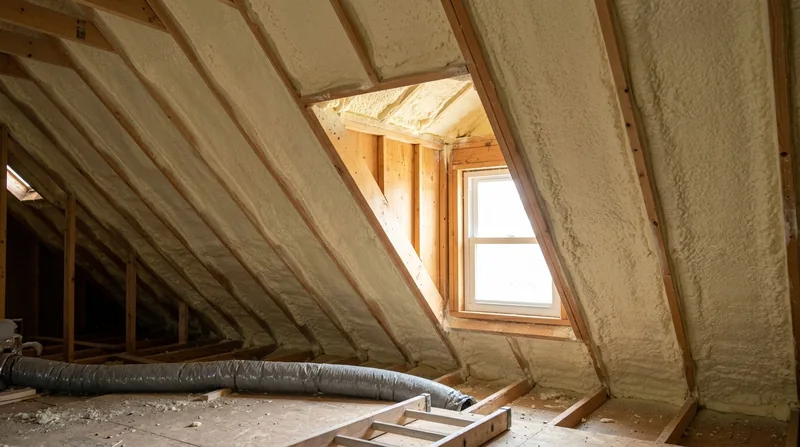




Open cell spray foam insulation in Aurora fills the stud cavities of your split-level walls and attic slopes without the weight and rigidity of closed cell. Aurora's housing stock spans pre-war homes along the Fox River, mid-century ranches toward Montgomery and Oswego, and newer two-story builds pushing south into Kendall County. Climate zone 5A means cold, windy winters with real snow load and hot, humid summers where vapor drive flips with the seasons. Open cell foam expands to seal small gaps around wiring and plumbing, helping interior walls and attic slopes hold steady through those swings. It is the price-friendly choice for sound dampening and thermal control when the structural demands of closed cell are not present. We have been installing spray foam insulation and air sealing across Greater Aurora since 2011.
Why Open Cell Spray Foam Matters in Aurora's Attics and Walls
Mid-century ranches and split-levels dominate Aurora's neighborhoods, and their attics carry decades-old fiberglass that has settled and thinned. Rim joists sweat in summer and freeze in winter. Interior walls in older homes were never insulated at all, leaving stud cavities exposed to outdoor temperature swings. Open cell foam fills those cavities and expands to seal the small gaps where air leaks form around electrical wiring, plumbing penetrations, and the corners where walls meet roof decks. Unlike closed cell, open cell is breathable, making it the right choice for interior wall retrofits and attic slopes where vapor permeability matters more than moisture barrier strength.
- Expands to fill irregular cavities and seal air leaks without adding structural weight.
- Costs less per board foot than closed cell, making it the practical choice for large attic areas and full-wall retrofits.
- Absorbs sound, reducing noise transmission through walls and making it a natural fit for bonus rooms over garages.
- Breathes with seasonal humidity swings, preventing moisture trapping in Aurora's hot, humid summers and dry winters.
- Works on existing wall cavities without demolition, letting us retrofit pre-1980 homes without tearing out drywall.
These qualities make open cell the workhorse for attic top-ups and interior wall insulation across Aurora, Naperville, Joliet, and the surrounding Fox Valley.
Key info: Aurora's split-levels and ranches often have uninsulated stud cavities in exterior walls and attic slopes that have never had any foam. Open cell fills those spaces at a fraction of the cost of a full closed cell retrofit, and the sound dampening is a real bonus in homes where bedrooms sit above garages or near shared walls.
For more context on how spray foam works across different building assemblies, see our guide to attic spray foam insulation in Aurora.
How We Install Open Cell Spray Foam in Aurora Homes
Installation starts with a site visit to measure cavities, identify air leaks, and confirm that the substrate is dry and sound. We identify any existing moisture, settling, or contamination that would prevent foam adhesion. The foam is sprayed in thin, controlled passes so that each layer cures properly before the next is applied. Mechanical ventilation runs during cure to manage off-gassing. We protect floors, fixtures, and adjacent areas with sheeting and tape. After cure, we trim excess foam flush with the framing and install the thermal and ignition barriers required by the building code at your address.
- We inspect the substrate and confirm it is dry before any foam is sprayed.
- Foam is applied in controlled passes at the manufacturer-specified ratio and drum temperature.
- Mechanical ventilation runs continuously during cure to manage VOC off-gassing.
- We trim excess foam and install code-required thermal and ignition barriers per your local building department.
- A re-entry window of 24 to 48 hours is observed before the space is occupied or covered.
The process is straightforward and non-invasive, and most attic and wall jobs are completed in a single day.
Example: A 1,600 sq ft ranch in North Aurora with an uninsulated attic and thin fiberglass in the rim joist cavity typically takes one day. We spray the attic slopes with 5.5 inches of open cell (R-19 to R-21), then move to the rim joist and seal the band board. The homeowner sees immediate thermal improvement in the upstairs bedrooms and a quieter attic space during wind events.
Learn more about how we handle air sealing around foam installations to maximize energy performance.
Open Cell Spray Foam Installation Methods and Best Uses
| Approach | Description | Best For |
|---|---|---|
| Attic slope spray | Open cell applied to the underside of the roof deck, creating a sealed assembly that eliminates attic ventilation. | Mid-century and newer homes where attic space is unfinished and roof trusses are exposed or accessible. |
| Stud cavity fill | Foam injected or sprayed into exterior wall cavities from inside, filling around electrical wiring and plumbing without demolition. | Pre-1980 homes with uninsulated walls, retrofits where exterior cladding cannot be disturbed, and historic properties. |
| Rim joist and band board | Foam applied to the rim cavity and band board, sealing the junction between foundation and framing where cold air enters in winter. | Basements and crawl spaces in homes of any age, especially those with sweating rim joists in summer or ice dams in winter. |
| Garage ceiling and bonus room | Open cell sprayed into the ceiling cavity above a garage or under a bonus room, providing thermal break and sound dampening. | Two-story homes with finished rooms above garages, where noise and temperature control are priorities. |
| Crawl space walls and rim | Foam applied to the interior face of foundation walls and rim joists in a vented or semi-conditioned crawl space. | Crawl spaces in climate zone 5A where moisture control and thermal efficiency are both required. |
Open Cell Spray Foam Insulation Cost in Aurora: What to Expect
Open cell spray foam in Aurora typically starts at $0.55 per board foot, which translates to roughly $1.10 to $1.65 per square foot for a 2-inch to 3-inch application. A 1,500 sq ft attic with 5.5 inches of open cell runs $4,500 to $6,500 before permits and thermal barrier installation. The actual cost depends on cavity depth, substrate condition, access difficulty, and whether existing insulation must be removed first. Homes in Naperville, Bolingbrook, and Oswego with complex roof lines and multiple penetrations often run higher than simple ranch attics in North Aurora. We provide a written estimate with R-value and thickness specifications before any work begins.
- Board foot price reflects the depth and coverage area of the foam application, measured on site.
- Substrate preparation, such as removing old fiberglass or sealing active leaks, is quoted separately.
- Thermal and ignition barriers required by code are included in the estimate.
- Travel and equipment setup across Aurora and surrounding areas are included in the per-board-foot rate.
The fastest way to lock in an accurate price is to review our pricing overview and call (331) 258-5715 for a free estimate with no obligation to book.
Cost example: A 1,200 sq ft attic in Bolingbrook with 4 inches of open cell foam and existing fiberglass removal runs $3,200 to $4,200. A full 5.5-inch application on the same footprint runs $4,500 to $5,500. If rim joist and band board sealing are added, add $800 to $1,200 depending on perimeter length and access.
What to Look for When Hiring an Open Cell Spray Foam Contractor Near Aurora
A professional spray foam contractor in Aurora, Joliet, Elgin, or anywhere in the Fox Valley should provide a written estimate that names the R-value and thickness you will receive, specify the foam type and manufacturer, and explain what is and is not included in the price. The contractor should verify that they carry full insurance and ask to see the certificate of insurance. Ask for references from recent jobs in your neighborhood and call at least two. Confirm that the contractor understands local permitting and building code requirements at your address. If your home is in an HOA or historic district, verify that spray foam work is permitted under architectural guidelines.
- Get a written estimate with R-value, thickness, and foam type named before any work is discussed.
- Confirm full insurance coverage and request a certificate of insurance for your records.
- Call references from jobs completed in the last 12 months and ask about cure time, re-entry, and long-term performance.
- Ask about permitting: does the contractor help navigate local requirements, or do they leave you to sort it out.
- If your home is in a master-planned community or historic district, verify that spray foam is allowed under local rules.
- Avoid any estimate with no R-value and thickness, no mechanical ventilation mentioned during cure, or immediate re-entry promised.
A contractor who walks away from a wet substrate or an active roof leak is the one you want. That discipline is the hallmark of professional work. Contact us for a free estimate and we will walk you through exactly what to expect.
Open Cell Spray Foam Insulation in Aurora: Pricing Guide
| Service | Price | Details |
|---|---|---|
| Open cell spray foam, 2 to 3 inches | Starting at $0.55/board ft | Covers attic top-ups and shallow wall cavities, typical R-value 7 to 10, measured and sprayed on site |
| Open cell spray foam, 4 to 5.5 inches | Starting at $0.55/board ft | Full attic slope coverage and deeper wall cavities, R-value 14 to 19, includes thermal and ignition barriers per code |
| Existing insulation removal and replacement | On estimate | Cost depends on insulation type, volume, disposal, and substrate condition after removal, quoted separately from new foam |
| Rim joist and band board sealing | Starting at $0.55/board ft | Measured by perimeter and cavity depth, typical basement or crawl space job runs $800 to $1,500 depending on access |
| Travel and equipment setup | Included | No separate mileage or call-out fee across Aurora, Naperville, Joliet, Elgin, and surrounding service areas |
| Free written estimate | No charge | Response within 24 hours at (331) 258-5715, includes site visit, R-value and thickness specifications, no obligation |
Indicative pricing, the exact cost depends on square footage, finish, and site access. Free personalized estimate within 24h at (331) 258-5715.


