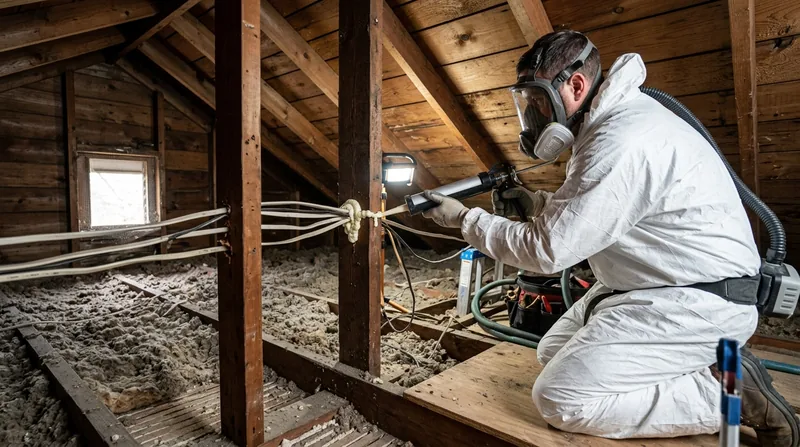




The air sealing work that stops winter cold and summer humidity from leaking through your Aurora home starts with understanding where the gaps are. Stack effect pulls cold air through rim joists, top plates, and wiring penetrations all winter long, draining heat and driving up your utility bills. In spring and summer, humid Fox Valley air reverses direction, pushing moisture into walls and attics where it condenses on rim joists and band joists. We seal those gaps with spray foam and caulk so basements and attics hold steady through both seasons. Whether your home sits along the Fox River in older downtown Aurora, spans a mid-century ranch toward Montgomery, or rises as a newer two-story toward Naperville, the air paths are the same: they run cold in January and damp in July. Getting ahead of those leaks is the fastest way to stabilize your energy bills and protect the structure underneath.
Why Air Sealing Matters in Aurora's Climate
Aurora sits in IECC climate zone 5A: cold, windy winters with real snow load and hot, humid summers where thunderstorms roll through the Fox Valley. That seasonal flip means your home faces two very different failure modes. Winter cold drives stack effect, pulling outside air down through the rim joist and up through the attic as warm air escapes. Summer humidity reverses that flow, pushing moisture inward where it condenses on cold rim joists and band joists in basements. The older homes along the Fox River and through downtown Aurora were never designed with rim joist insulation or sealed top plates, so they leak hard both ways. Mid-century ranches and split-levels toward Montgomery and Oswego sit over full basements where damp concrete meets uninsulated rim joists every summer. Newer two-story homes with bonus rooms over garages and complex roof lines face their own stack effect through multiple vertical zones. Sealing those gaps stops the cycle before it starts.
- We locate and seal rim joists and band joists where the house frame meets the foundation wall, the single biggest air leak in most Aurora homes.
- We seal top plates at the attic floor where the second story meets the roof, blocking stack effect from pulling warm air out in winter.
- We seal wiring penetrations, plumbing chases, and ductwork transitions where rough carpentry creates unintended gaps.
- We use spray foam or caulk depending on the gap size and depth, always choosing the material that holds its seal through thermal cycling and humidity swings.
These four zones account for the majority of air leakage in Aurora's residential stock, and sealing them cuts winter heating loss and summer humidity intrusion dramatically.
Local example: A 1970s split-level in Oswego with a full basement and an uninsulated rim joist typically loses 30 to 40 percent of its winter heating through that single zone. Sealing the rim joist and the band joist above it, plus the top plate at the attic floor, stops that loss and brings the basement temperature up 5 to 8 degrees within a week. The same house in July sees humidity drop when we seal those same gaps, because outside air can no longer push moisture into the rim joist cavity.
Learn more about how attic spray foam insulation pairs with air sealing to complete your home's thermal envelope.
For permitting questions specific to your address in Aurora, Kane County, DuPage County, Kendall County, or Will County, contact your local building department. Illinois state requirements for spray foam application are enforced at the municipal level, and thermal barrier and ignition barrier rules vary by jurisdiction.
How We Air Seal Your Aurora Home: Step by Step
Air sealing is not a guessing game. We start with a visual inspection of the rim joist, band joist, top plate, and wiring penetrations, then we identify which gaps are large enough to seal with spray foam and which can be handled with caulk or backer rod. Rim joists in older Aurora homes are often 8 to 12 inches deep, and if there is existing fiberglass or mineral wool inside, we remove it first so the new foam bonds to clean wood. We then seal the rim joist perimeter, the band joist above, any visible wiring or plumbing penetrations, and the top plate where the second story meets the roof. On two-story homes with garage ceilings, we seal those zones too. The work takes a day or less on most residential jobs, and the result is a home that holds its temperature and humidity steady instead of chasing the outside air.
- We inspect the rim joist, band joist, top plate, and wiring penetrations to map all visible air leaks.
- We remove any failed or settled insulation so spray foam or caulk bonds to clean wood or concrete.
- We spray closed cell foam or open cell foam depending on the gap depth and the moisture exposure at that location.
- We trim and finish the foam so it sits flush with the joist and does not interfere with future drywall or rim joist repairs.
- We caulk smaller gaps and wiring penetrations where spray foam would be overkill.
- We verify the seal by checking for air movement with a smoke pen or visual inspection of the cured foam.
The entire process is straightforward and non-invasive, requiring no structural changes or major disturbance to the finished house.
Local example: A pre-war home in North Aurora with a full basement and a 10-inch rim joist cavity typically has 3 to 5 linear feet of rim joist per linear foot of foundation perimeter. If the basement is 40 feet by 30 feet, that is roughly 280 linear feet of rim joist to seal. Sealing the full perimeter with closed cell spray foam plus caulked penetrations takes one day and costs in the $1,200 to $1,800 range. The homeowner sees a 5 to 10 degree rise in basement temperature in winter and a noticeable drop in summer humidity within two weeks.
See how rim joist and band joist spray foam fits into the larger air sealing strategy for your home.
| Sealing Method | Description | Best For |
|---|---|---|
| Closed Cell Spray Foam | High-density foam that hardens rigid, blocks moisture, and provides structural reinforcement. Applied at 1.5 to 2 pounds per cubic foot. | Rim joists and band joists in basements, where moisture risk is high and vapor control matters. |
| Open Cell Spray Foam | Lower-density foam that cures softer and is easier to trim. Breathable to moisture, so it must be paired with a vapor barrier in wet zones. | Attic rim joists, top plates, and wiring penetrations where moisture risk is lower and ease of trim matters. |
| Polyurethane Caulk | Flexible sealant that moves with thermal cycling. Applied by gun to gaps under 1/2 inch wide. | Wiring penetrations, small cracks in rim joists, and transitions between spray foam and drywall. |
| Backer Rod and Caulk | Closed-cell foam rod inserted into a gap, then caulked over. Fills deep cracks without wasting spray foam. | Large horizontal cracks in rim joists or concrete foundations where spray foam would be inefficient. |
Air Sealing Cost in Aurora: What to Expect
Air sealing projects in Aurora typically start at $650 for a small rim joist zone or a handful of penetrations, and rise depending on the total linear footage of rim joist, the depth of the cavity, the type of foam chosen, and the labor required to access the work. A full basement rim joist seal on a mid-sized home usually runs $1,200 to $2,000. A complete air sealing package that includes rim joist, band joist, top plate, and wiring penetrations across a full two-story home can reach $2,500 to $4,000. The main factors that move the price are the linear footage of rim joist to seal, whether existing insulation needs removal first, the foam type chosen (closed cell costs more than open cell), and the accessibility of the work. Crawl spaces and finished basements with drywall already in place cost more because we must work carefully to avoid damage. Attic work is usually faster because there are fewer obstructions. Travel is included in our service area across Aurora and surrounding communities, so there is no separate mileage fee.
Getting two or three estimates before you commit is smart practice. A good estimate should itemize the linear footage of rim joist, the foam type and thickness in inches, the R-value per inch, the total board feet of foam, and the labor scope. Estimates that skip those details or offer a price far below market with no inspection are a red flag. We provide written estimates with R-value and thickness specifications so you know exactly what you are paying for.
Visit our full pricing overview to see the complete range of our air sealing and related insulation services.
What to Look for When Hiring an Air Sealing Contractor Near Aurora
Choosing the right contractor for air sealing work in Aurora, Naperville, Oswego, or any surrounding area comes down to three things: verification of insurance, clarity on scope and pricing, and a realistic timeline. Start by asking any contractor for proof of current insurance and a certificate of insurance naming your address as the job location. Call the insurance company directly if you have any doubt, because insurance that cannot be verified is insurance that will not pay a claim if something goes wrong. Ask for at least two references from similar homes in your area, and call them. A good contractor will have homeowners willing to talk about their rim joist sealing or top plate air sealing work. Second, get a written estimate that specifies the linear footage of rim joist to seal, the foam type, the thickness in inches, the R-value, and the total board feet. A price without those details is a guess, not an estimate. Third, ask about permits. Air sealing work in most Aurora jurisdictions does not require a permit, but your local building department can confirm that for your address. If the contractor promises an unrealistic price or timeline, or if they want to start work before you have a signed contract, walk away.
We are fully insured, and we provide free written estimates with R-value and thickness specifications so you can compare apples to apples. Contact us today for a no-obligation estimate at (331) 258-5715.
Air Sealing in Aurora: Pricing Guide
| Service | Price | Details |
|---|---|---|
| Rim Joist Air Sealing (single zone, under 100 linear feet) | Starting at $650 | Includes inspection, removal of failed insulation, spray foam seal, and caulked penetrations on one rim joist section |
| Full Basement Rim Joist and Band Joist Seal | Starting at $1,200 | Complete perimeter seal on basement rim joist plus band joist above, typically 250 to 350 linear feet of sealing |
| Complete Home Air Sealing (rim joist, top plate, penetrations) | Starting at $2,200 | Basement rim joist, attic top plate, garage ceiling if present, plus all wiring and plumbing penetrations throughout the home |
| Attic Top Plate and Penetrations Only | Starting at $750 | Seals the top plate where the second story meets the roof and all wiring penetrations in the attic floor |
| Estimate | Free | Written estimate with R-value and thickness specifications, response within 24 hours at (331) 258-5715 |
Indicative pricing, the exact cost depends on square footage, finish, and site access. Free personalized estimate within 24h at (331) 258-5715.


