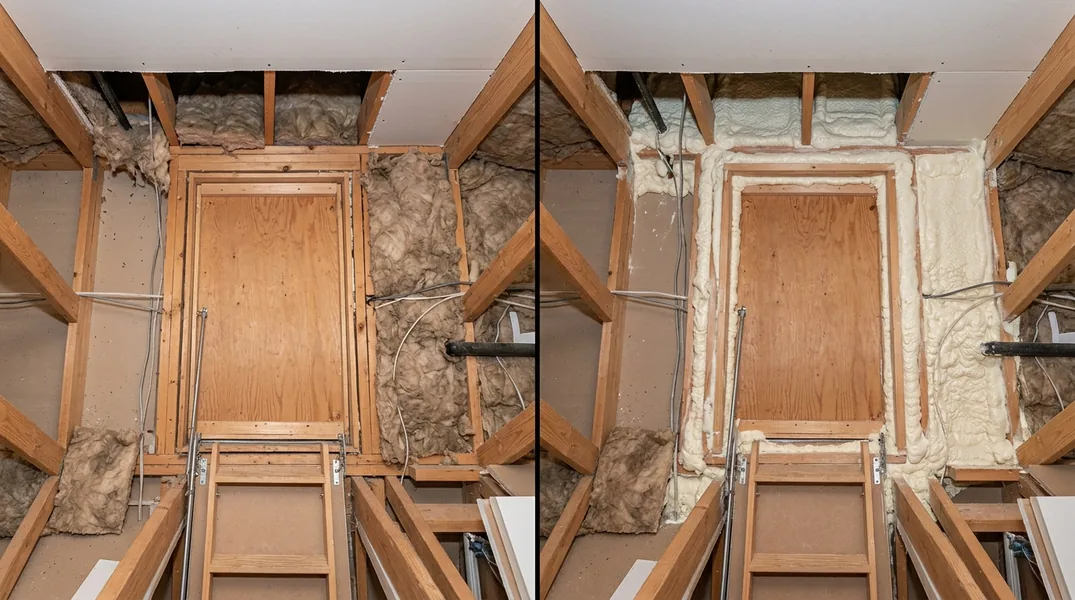
Understanding Your Aurora Attic's Current Insulation
If you own a home in Aurora, your attic is one of the most critical areas for energy efficiency. Many homeowners don't realize that a poorly insulated attic can account for up to 25 percent of your home's heat loss during winter months. Before deciding whether you need air sealing, a top-up, or a complete Attic Spray Foam Insulation installation, you need to understand what you're working with.
Start by having a professional assess your current insulation depth and condition. Many older homes in Aurora have fiberglass batts that have settled over decades, leaving gaps and reducing their effectiveness. The question isn't just about how much insulation you have, but whether it's performing its job. Air leaks around penetrations, inadequate coverage, and moisture damage can all render existing insulation less effective than its R-value suggests.
Air Sealing: The Foundation of Attic Efficiency
Air sealing is often the first step in any attic efficiency project, and it's frequently overlooked by homeowners who jump straight to adding more insulation. Think of air sealing as plugging the holes in your bucket before filling it with water. No matter how much insulation you add, if warm air is escaping through gaps around electrical boxes, plumbing penetrations, or roof vents, you're throwing money away on energy bills.
Common air leak locations in attics include the top plates of exterior walls, gaps around ductwork, unsealed recessed lights, and poorly sealed attic hatches. A professional energy audit can identify these problem areas using thermal imaging or blower door tests. Many homeowners find that addressing air leaks alone can improve comfort and reduce heating and cooling costs by 10 to 15 percent. The cost of air sealing is typically modest compared to full insulation upgrades, making it an attractive option if your existing insulation depth is already adequate.
Spray Foam Insulation R Value Per Inch: Understanding Your Options
Closed Cell Spray Foam Insulation typically delivers an R-value of 6.0 to 6.5 per inch, while Open Cell Spray Foam Insulation provides approximately 3.5 to 3.6 per inch. This means that closed cell foam is significantly more efficient in terms of space, which matters when you're working with limited attic height. If your attic has structural constraints or you're trying to maximize efficiency in a compact space, closed cell is the premium choice. Open cell foam, while less dense, still offers excellent performance and is often more affordable.
When comparing spray foam to traditional fiberglass batts (which provide about 3.2 R-value per inch), spray foam's superior performance per inch becomes clear. Additionally, spray foam creates an air seal as it expands, eliminating the need for separate air sealing work in most cases. This dual benefit of insulation plus air sealing makes spray foam particularly attractive for homeowners seeking comprehensive attic performance improvement. The question of how thick spray foam should be depends on your state's R-value requirements and your home's specific needs.
R Value Requirements by State: What Illinois Demands
Illinois has established minimum insulation standards for residential attics, and understanding these requirements is crucial for compliance and efficiency. For attics in Illinois, the recommended R-value is typically R-38 to R-49, depending on whether you're in a heating-dominated or mixed climate zone. Aurora falls within the region where R-38 is the minimum baseline, though many energy-conscious homeowners opt for R-49 to achieve superior performance.
To achieve R-38 with closed cell spray foam, you would need approximately 6 to 6.5 inches of material. With open cell foam, you'd need about 10.5 to 11 inches. With traditional fiberglass batts, you'd need around 12 inches of properly installed material. These requirements aren't just suggestions; they're relevant to building codes, insurance considerations, and your eligibility for rebates. Before proceeding with any insulation project, verify the specific requirements for your property and discuss them with a qualified professional.
Rebates: Making Your Upgrade More Affordable
The federal insulation tax credit ended on December 31, 2025, so ask your utility company about any current rebates instead.
Many utility companies and state programs offer additional insulation rebates for qualifying efficiency upgrades. Illinois residents should check with their local utility provider to see what programs are available in their service area. Some programs offer rebates specifically for spray foam insulation, while others may have broader energy efficiency incentive programs. When you contact Aurora Spray Foam Insulation at (331) 258-5715 for a free estimate, our team can help you understand which incentives apply to your specific project and ensure your installation meets all requirements for claiming these credits.
When Topping Up Is Enough: Making the Right Decision
Not every attic insulation project requires a complete tear-out and reinstall. If your existing insulation is in good condition, properly installed, and your attic has adequate air sealing, adding more insulation on top (sometimes called a top-up) may be sufficient. This approach works best when your current insulation depth is close to meeting modern standards but falls slightly short. For example, if you have R-30 and need R-38, adding R-8 of new material on top is often more cost-effective than removing and replacing everything.
However, a top-up approach has limitations. If your existing insulation is wet, compressed, contaminated, or unevenly distributed, simply adding more material on top won't solve the underlying problems. Additionally, if your attic has significant air leaks or structural issues like roof damage, you'll need to address these before adding insulation. The best way to determine whether air sealing alone, a top-up, or full spray foam insulation is right for your home is to schedule a professional assessment. Our team at Aurora Spray Foam Insulation can evaluate your current situation and recommend the most cost-effective solution for your needs.
How Thick Should Spray Foam Be: Finding Your Optimal Depth
The ideal thickness of spray foam insulation depends on several factors: your state's R-value requirements, the type of foam you choose (closed cell versus open cell), your budget, and your long-term energy efficiency goals. As mentioned earlier, achieving R-38 with closed cell foam requires approximately 6 to 6.5 inches, while open cell needs roughly 10.5 to 11 inches. If you're aiming for R-49 (a premium efficiency level), closed cell would need about 8 inches, and open cell would require 14 inches or more.
Beyond minimum code requirements, consider your home's age, current energy bills, and climate control challenges. Homes with vaulted ceilings, complex roof lines, or poor existing insulation may benefit from the maximum recommended thickness. Additionally, spray foam's air-sealing properties mean you may achieve better overall performance with less total R-value compared to traditional insulation, because you're eliminating air infiltration losses. When you get a free estimate from Aurora Spray Foam Insulation, our specialists will recommend the optimal thickness for your specific situation, taking into account your pricing considerations and efficiency goals.
Looking for a professional spray foam insulation contractor in Aurora? Aurora Spray Foam Insulation responds fast for all your spray foam insulation needs.
Get a Free Quote